Wyden presses to lift federal ban on industrial hemp

Talks on Senate floor to mark National hemp History Week

From KTVZ.COM news sources
POSTED: 7:29 PM PDT June 4, 2015  UPDATED: 7:29 PM PDT June 4, 2015


Sen. Wyden backs lifting ban on industrial hemp

Sen. Ron Wyden, D-Ore., takes to Senate floor to urge colleagues to lift ban on industrial hemp


WASHINGTON –

Sen. Ron Wyden, D-Ore., on Thursday again urged lifting the federal ban on industrial hemp, saying it has a wide variety of uses and economic benefits in Oregon and nationwide.

Hemp-based products contributed $620 million to the U.S. economy in 2014, but current federal regulations prohibit farmers from growing hemp in the United States, the senator noted.

“I’ve long said if you can make it and sell it in Oregon, you should be able to grow it in Oregon,” Wyden said in a speech on the Senate floor in recognition of National Hemp History Week.

“In my view, keeping the ban on growing hemp makes about as much sense as instituting a ban on Portobello mushrooms,” he said. “There’s no reason to outlaw a product that’s perfectly safe because of what it’s related to.”

Wyden highlighted several products made in Oregon from industrial hemp by companies such as Milwaukie-based Bob’s Red Mill, which produces protein powder from hemp seeds, Creswell-based Fiddlebumps, which makes hemp butter and other skin care products, and Eugene-based Hemp Shield, which makes deck sealant and wood finish from hemp.

Wyden introduced a bill earlier this year with Sen. Mitch McConnell, R-Ky., to lift the ban on growing hemp domestically. The Industrial Hemp Farming Act, S. 134, would distinguish between industrial hemp and marijuana under the Controlled Substances Act. Sens. Rand Paul, R-Ky., Jeff Merkley, D-Ore., Steve Daines, R-Mont., Al Franken, D-Minn., and Cory Gardner, R-Colo., also cosponsored the bill.

CONTINUE READING…

Categories: US Hemp Co Museum | Leave a comment

Film screening promotes Hemp History Week

By Whitney Leggett The Winchester Sun


Film screening promotes Hemp History Week Local store puts focus on commerical, industrial uses


Marijuana’s misunderstood cousin is making a comeback in Kentucky and on a local level.

In 2013, the Bluegrass State became the first to legalize hemp production. Riding on the support of U.S. Sens. Mitch McConnell and Rand Paul, along with Agriculture Commissioner James Comer, the legislation expanded a market for thousands of products produced using the crop.

One local business is joining the efforts of raising awareness and acceptance of the industrialization of hemp.

Full Circle Market is celebrating Hemp History Week through Saturday with special promotions and a movie screening at the Clark County Public Library.

The market, located at 240 Redwing Drive, sells vitamins, minerals, herbs, natural body care products, eco-friendly cleaning supplies and specialty food items. Among the merchandise sold at Full Circle are a variety of hemp products, owner Laura Sheehan said.

“We sell hemp products here at the store, and have sold hemp products since we opened (in 2001),” Sheehan said.

In its sixth year, Hemp History Week is a national campaign to educate and renew support for hemp farming in the U.S.

This year, Sheehan has taken the local campaign efforts to a new level.

“Full Circle Market has participated in Hemp History Week for the last three years,” she said. “This year as part of Hemp History Week they offered opportunities to show the movie ‘Bringing It Home’ to your community. I thought it would be a natural fit to educate people since now hemp can legally be grown in Kentucky. I thought it would be a good time to bring this movie to the community to show it so they can learn about the industrialization of hemp first-hand.”

According to the film’s website, “Bringing It Home,” filmmakers Linda Book and Blaire Johnson “animate hemp’s history and introduce us to business owners using industrial hemp for construction, textiles, nutrition and body care products in the U.S. and around the globe.”

Book and Johnson explore why hemp isn’t grown in the U.S. and expose some of the latest legislative efforts to legalize hemp production in the U.S.

The 52-minute documentary-style film will be shown for free at 7 p.m. Monday, June 8, at the Clark County Public Library, and Sheehan thinks the film will shed some much-needed light on the hemp industry.

“I think people will be interested to know that hemp is not marijuana,” she said. “Hemp is a viable crop that actually has negative carbon emissions. So it is a very green crop.”

Although hemp is a variety of cannabis and of the same variety of plant as marijuana, it has no drug value, according the Kentucky Department of Agriculture.

KDA reports hemp seed contains little to no measurable amounts of tetrahydrocannabinol (THC), the primary psychoactive ingredient in drug varieties of cannabis. THC levels for hemp are around 0.3 percent, while marijuana THC levels are 10 percent on average.

For Sheehan and most other hemp proponents, the potential financial benefits of industrialized hemp production cannot be ignored.

“We sell millions of dollars of hemp products in the U.S. from food to fiber and fuel,” she said. “But we are importing it from around 30 others countries around the world. At this point, we as Americans have an abundance of farmers and farmland. So why not be growing it ourselves? The laws prohibiting hemp are really outdated and I feel strongly if it’s something we can source locally, our store wants to do that. I think this movie teaches us that it’s time to grow (hemp) here in the U.S.”

Sheehan said she hopes Kentucky can become known for its hemp production.

“I think it’s really exciting for Kentucky to be the first state to get to grow it,” she said. “There are other states behind us that are starting to legalize hemp. But if we can one day be known as the hemp capital of the world, that would be great. I think the revenue that can be made from hemp will really help our state, and it’s wonderful timing that our state is the first to get this crop planted.”

Prior to the screening of the film, there will be informational booths and samples of hemp products available from 5 to 7 p.m. at the library. Representatives from Plowshares for Appalachia, Atalo Holdings and Kentucky Hemp Industries Association will be available to answer questions.

“I think farmers are interested, but they don’t know how to get started,” Sheehan said. “What’s the application process like? How much land do I have to have? What do I do with my plant once I harvest it? There will be people there to help answer all these questions.”

Full Circle sells body care products made with hemp oil as the moisturizing base, as well as several hemp food products.

Visitors to the store can find chocolate covered hemp hearts (seeds), hemp protein powder, granola bars with hemp, hemp milk, hemp lotion, hemp soap (bar and liquid) and even a hemp shaving cream. Hemp twine, which is popular among local gardeners, is also available, Sheehan said.

Hemp is high in Omega 3, and is a good source of protein and fiber, she said.

As part of her Hemp History Week celebration, Sheehan will offer samples, special promotions and prize giveaways.

For more information about Hemp History Week, visit hemphistoryweek.com.

For questions about Full Circle Market products, Hemp History Week promotions or the movie screening, call Sheehan at 744-3008.

Contact Whitney Leggett at wleggett@winchestersun.com or follow her on Twitter @whitneyleggett.

CONTINUE READING…

Categories: US Hemp Co Museum | Leave a comment

AMERICAN GREEN, INC.


Image result for kentucky hemp


American Green Inc (OTCMKTS:ERBB) recently released that the first of five ZaZZZ machines currently slated for Kentucky made headlines at the state’s Industrial Hemp Pilot Program Update in Lexington. Agriculture Commissioner James Comer of the Kentucky Department of Agriculture invited American Green marketing partner Chris Smith of Green Remedy (http://www.greenremedy.com) to talk about the future of hemp in the Bluegrass State. Green Remedy, which is comprised of John Salsman, Mike Boone, Chad Wilson, as well as Chris Smith is currently located in Bardstown, KY. American Green Inc (OTCMKTS:ERBB) advanced 1.82% and ended at $0.00560. The total traded volume was 9.11 million shares and market capitalization arrived at $24.84 million. The stock has a 52-week high price of 0.04 and its 52-week low was recorded at $0.01, while during last trade its minimum price was $0.01 and it gained the highest price of $0.01.

CONTINUE READING…

Categories: US Hemp Co Museum | Leave a comment

Banking on industrial hemp

Posted on May 29, 2015
by Dan Dickson

Industrial hemp is getting a lot of ink, air time and social media attention in Kentucky lately.

In the second year of the state’s hemp pilot program, 121 farmers were selected to grow a total of 1,740 acres of the crop in demonstration projects that industry leaders hope will prove the potential of hemp. But is hemp a good investment? Should banks and individual investors be sinking money into it?

“We’re absolutely excited about it,” said Debra Stamper, counsel for the Kentucky Bankers Association. “Any new industry is great for the economy, which means it’s great for the banks.”

Stamper said she’s impressed by the wide range of products produced from hemp, everything from clothing, oils and personal care products to automobile parts and food.
“Kentucky has such a rich history of hemp production for products,” she said. “It could help farmers who used to grow tobacco, especially smaller farms.”

Bank loans for Kentucky agriculture have fallen off in recent years, according to the association.

While hemp might provide a boost, Stamper said she thinks Kentucky bankers need to be reassured that investing in hemp is safe. The federal farm bill allows certain states to operate hemp pilot programs.

“I would argue quite strongly that that allows Kentucky banks, any bank, in states where hemp is legal, to hold money and make loans for hemp projects authorized by the pilot programs,” said Jonathan Miller, of Lexington’s Frost Brown Todd Attorneys and advisor to the Kentucky Hemp Industry Council.

Some Kentucky bankers recently met with hemp industry leaders and Agriculture Commissioner James Comer. They talked about a hemp education curve. Bankers must understand the differences between a legal hemp crop and an illegal marijuana crop. Officials discussed with bankers how to verify the people who approach them for loans for hemp projects, “so they’re not hesitant about getting involved in any of those businesses,” said Stamper.

Still, some bankers worry getting involved in hemp might bring the U.S. Drug Enforcement Administration to their door or lead to a crackdown from the Federal Deposit Insurance Corporation.

“That is something we’re working through right now,” Miller acknowledged.
But, Miller said, from an investment standpoint, now is the time to to get in on the ground floor of the state’s hemp industry.

“Given our history of world leadership in hemp a century ago, our soil and climate and the political support for it today, I would think investing in Kentucky hemp would be a wise bet,” he said.

Large and small banks have shown interest in hemp. Smaller banks might be in the best position to get into the business since they’re experienced with loaning to small farmers and business owners.

Pages: 1 2

– See more at: http://bizlex.com/2015/05/banking-on-industrial-hemp/#sthash.aNwpHmGP.dpuf

Categories: US Hemp Co Museum | Leave a comment

Waiting for American Green Inc (OTCMKTS:ERBB) 0

By Justin Kinney on May 20, 2015 Media & Technology, Micro Cap Insider

American Green Inc (OTCMKTS:ERBB) continues to drop farther below $0.01 after eclipsing that support level. The stock does still have a loyal shareholder base that are waiting for a reversal.

On May 5 ERBB said the first of five ZaZZZ machines currently slated for Kentucky made headlines at the state’s Industrial Hemp Pilot Program Update in Lexington.

Agriculture Commissioner James Comer of the Kentucky Department of Agriculture invited American Green marketing partner Chris Smith of Green Remedy to talk about the future of hemp in the Bluegrass State. Green Remedy, which is comprised of John Salsman, Mike Boone, Chad Wilson, as well as Chris Smith is currently located in Bardstown, KY. They ordered five ZaZZZ machines in February 2015, the first of which was delivered, wrapped and shown off to the public today.

American Green Inc (OTCMKTS:ERBB) ZaZZZ vending machine is a unique automated vending solution designed specifically around American Green’s licensed proprietary patented technology. The machine is designed to make age-verified vending of cannabis products a reality, by providing a layer of authorization using the same systems as pharmacies for purchase regulation. It is designed to facilitate fully unattended purchases inside a dispensary or other regulated cannabis establishment.

The Company launched the ZaZZZ earlier this year in Colorado at a medical marijuana dispensary called Herbal Elements in Eagle Veil. Several days ago AG announced that zazzznetwork.com was online and displaying the first locations to have the age-verifying ZaZZZ product fulfillment machines fully online.

Currently the zazzznetwork.com shows ZaZZZ vending machine installed at Hempful Farms, Inc., in Phoenix, Arizona, AG HQ in Tempe, Arizona, Nature’s Kiss in EngleWood, Colorado, Kind Therapeutics in Colorado Springs, Colorado, Rocky Mountain Miracles in Colorado Springs, Colorado, Natural Herbal Pain Relief in San Jose, California, Pacific Coast in Seattle, Washington, Seattle Caregivers in Seattle, Washington and The Peoples ChampZ in Seattle, Washington.

Carl Kaiser, VP of the Verified Vending division said “As our ZaZZZ machine network expands to more locations, we plan to never stop incorporating new features and improvements. Catering to the early adopters, we left the product selection mostly to their discretion. As we progress, we’ll eventually direct the product selection so ZaZZZ Machines arrive with the images loaded and the inventory available and accounted for. Thus, the sixteen square feet in some random corner of the seller’s facility that currently is occupied by an unused chair and a poster on the wall instantly transforms into revenue-generating floor space for the business.”


ERBB is the brainchild of CEO Stephan Shearin who also serves as ERBB COO. Mr. Shearin has over 15 years of Internet business experience and over 20 years of start-up experience. He graduated from Arizona State University with a Degree in sociology and previously owned an underwater video business on St Thomas and an online bank.

On March 31 ERBB announced a Collaboration Agreement with Endexx to jointly develop the “Access Control Identification & Verification Vending Platform” aka “ACIDVP.” Each company designs and markets systems to address the issues related to the automated dispensing and inventory control of products requiring eligibility verification in compliance with applicable laws for the Marijuana Industry.

Together, they will co-develop and license an Integration and Connectivity Interface Platform to foster required industry standardization. The on-going collaboration also enables the companies to share business relationships leading directly to mutual revenue potential for both organizations.

The scope of the collaboration comprises the establishment of a unified compliance standard for inventory control and verified vending for general adoption by regulators and local jurisdictions in multiple legal markets.

The agreement also calls for collaboration on technology connectivity with the integration of American Green’s “Verify Pay” POS (Point of Sale) system with Endexx’s proprietary M3Hub inventory control, tracking, and process management system and for the joint development, marketing, distribution and licensing of the M3Hub universal interface connectivity platform for all third party “Seed-to-Sale,” POS systems and vending solutions.

CONTINUE READING…

Categories: US Hemp Co Museum | Leave a comment

Hemp History Week coming up Events taking place from June 1st -7th, 2015

By Diego Flammini, Farms.com

In an effort to raise awareness about hemp and its place as a sustainable, versatile and profitable agricultural product, the Hemp Industries Association (HIA) and Vote Hemp are putting together the 6th annual Hemp History Week, set to take place from June 1st – 7th, 2015.

The weeklong celebration, whose theme is “Sow the Seed” will highlight the many different industries that can benefit from hemp crops including manufacturing and cooking.

It will also highlight the spring planting and progress in the states that already allow large-scale hemp farms.

One of, and perhaps the main issue affecting hemp’s place as an agricultural commodity is that it’s closely associated with marijuana.

Here are some things that set hemp apart from marijuana:

  • While both marijuana and hemp are classified as the Cannabis sativa, hemp is taller and has less than 0.3% of THC, the chemical responsible for the effects of marijuana.
  • When hemp is grown and harvested on a large scale and used for things like oil, wax, soap, rope and paper, it can be classified as agricultural or industrial hemp.

Hemp rope

According to the Kentucky Department of Agriculture, retail sales of all hemp-based products in the United States could be worth approximately $300 million per year.

In 1938, Popular Mechanics deemed hemp the new billion-dollar crop.

Currently there are 13 states in the US that allow for commercial hemp farming: California, Colorado, Indiana, Kentucky, Maine, Montana, North Dakota, Oregon, South Carolina, Tennessee, Vermont, Virginia and West Virginia.

Tell us your thoughts about Hemp History Week and the events taking place. If you’re a hemp farmer, what are some of the myths that need to be dispelled surrounding hemp?

Additional related content…click below to see more :

(News): USDA releases four pillars of agriculture

(News): USA to consider repealing COOL

(Featured): Video: Agostino: Freak Snowstorm Delays Corn Planting And Worries Grain Market.

(Featured): FCC Video: Management Moment: Farmer to CEO

CONTINUE READING…

Categories: US Hemp Co Museum | Leave a comment

SC mom legally making and selling strain of medical marijuana

By Molly Grantham


South Carolina (WBTV) –

We can’t tell you where in South Carolina we are reporting this story. It’s down a dirt road, near horses and smack in the middle of a large field.

“I’m building my company here,” Janel Ralph says. “I think it’ll be up and running in maybe six months.” She laughs, “But I’m an optimist. I guess I can’t say exactly on the timeline.”

Janel Ralph’s company is called Palmetto Synergistic Research. She’ll be manufacturing hemp cannabis, legally, in South Carolina. She’s cultivating them to have specific genetics. What she’s making will be high in CBD – the part of the plant that is calming – and to have very little to no THC – the part of the plant that gives you that euphoric “high” feeling.

The result will be plants that will make CBD oil, a strain of medical marijuana.

How is this legal?

There is a hemp bill in South Carolina (S839) that allows for consumable hemp products with a profile of .3% or less of THC. Because of the bill, those “consumable products” aren’t considered marijuana, as defined by the State.

**SEE THE FULL BILL HERE**

Still, because of the controversy surrounding the word “marijuana”, Ralph would only do an interview on the condition we’d keep the location secret.

“There will be people who would intentionally try to steal it not knowing that it’s hemp,” she said. “Criminals could hear I’m manufacturing medical marijuana and think they could take it. They wouldn’t understand what I’m making has such a low THC, that even if they took the plants they couldn’t smoke it or sell it as marijuana. You can’t get high on what I’m making.”

Insurance also requires anonymity, but Ralph admits the secrecy is mostly for safety reasons.

“I’m doing something new and that scares people sometimes. So there’s a fear in it for me,” she said. “Ever since starting all this it has been a fear.”

Ralph started this process last year because of her own 5-year-old daughter, Harmony.

Harmony has a genetic condition called lissencephaly. Ralph says that means her brain is missing a deletion of one of her chromosomes and causes lots of seizures. After multiple other medications weren’t working, her mother wanted to try CBD oils.

“I knew CBD oil could be beneficial, yet, it was so hard to get,” Ralph said. “There’s an underground black market for this medicine. I know people who were getting products that weren’t what they were promised. I was able to find some for Harmony, and it worked. She was doing great! But then my supply started dwindling. I was scared to death. I thought at one point, ‘Oh my God, I’m going to have to cold turkey my daughter in taking this away.’”

She did have to take Harmony off of CBD oil. Ralph says at that point, Harmony started regressing.

“So I said, ‘Forget this. I’m done. I’m doing it myself’, she says. “I was just so frustrated. We’re talking about a hemp product. Let’s be real. This is CBD oil. CBD oil! It’s not a product high in THC. And yet, I couldn’t find it to give to my daughter. I was constantly begging people out in areas where it’s legal to find what they could and give it to us. Like some ‘Mommy Network.’ And it just got to the point where I was the one who needed this for my child, so I realized either I do it myself or sit back and be taken advantage of.”

She was determined to do it legally.

South Carolina’s vague hemp oil law says you can have CBD oils, but doesn’t say how you should or where you can get them. (North Carolina’s current law, signed by the Governor in July of 2014 and put into effect in October, says they can only be prescribed through four hospitals in the state, and only through pilot studies.)

But that wasn’t the main problem. Ralph said her issue with South Carolina’s bill was a separate part that said you can manufacture CBD oils if you’re a “licensed grower.” It just doesn’t define or say what kind of license you need.

“I started by contacting local law enforcement. I asked, ‘What do I need to do to grow hemp for medicinal value?’” She laughs. “I wanted to do it all on the up-and-up. Only, law enforcement had no idea.”

Ultimately she was told law enforcement has no jurisdiction. She says it was recommended she contact the Agricultural Department. But that department wasn’t sure either.

Throughout her research, Ralph realized South Carolina had cut-and-pasted much of its hemp oil bill from Kentucky’s hemp oil bill, which is a little more specific. So Ralph went to Kentucky, found a grower there who was “licensed” through the Agriculture Department in Kentucky, made him ten percent part business owner with her, and has now been able to tell South Carolina legislature – in multiple appearances before state representatives – she is following the law.

“I want to be compliant,” Ralph says. “I am not a criminal. I don’t want to be a criminal. I want to be transparent.”

Every time she looks at her daughter, she knows the intense efforts are worthwhile.

“Our hearts are in this,” she said. “This has been a terrible process. I’m in debt. I’m stressed. But there’s no other way. Everyone involved in my company has a child who can benefit from this medicine. We want this. We want this for our kids.”

Ralph says until her 25,000 square-foot greenhouse and 2,500 square-foot processing facility are built in the field where she talked to WBTV, she is making the CBD oil at a facility legally-approved by the Agriculture Department.

“We have 65 customers already,” she said. “Kids and adults.”

To find out more on Palmetto Harmony – the name of the CBD oil she’s making – or to contact Ralph, go to her company website here.

She says it also recently started being sold at two places in South Carolina – a store called Eucalyptus Wellness in Charleston and Emily McSherry, a licensed massage therapist.

CONTINUE READING…

Categories: US Hemp Co Museum | Leave a comment

Do You Know What’s on Your Weed?

If You Care About Ingesting Weed Free of Harmful Pesticides, You Need to Know a Crucial Difference Between Medical and Recreational Marijuana

by Tobias Coughlin-Bogue


Before looking into it, I naively assumed Washington State’s groundbreaking marijuana legalization law had given us a unique opportunity to do things “right,” which meant, to my mind, a crop that’s not only legal but pesticide-free, organic, and eco-friendly. Maybe we’ve all already given up hope when it comes to fruit and vegetables grown by giant agribusinesses, but weed, given all the tree-hugging, organic-food-eating, GMO-avoiding hippies who love it, must be different. Right?

Wrong. What I discovered was that legal weed is most certainly not pesticide-free, although to be fair, there are severe restrictions on the kinds of pesticides recreational marijuana growers are allowed to use. Pesticide use is so commonplace in agriculture that the question becomes one of degrees rather than absolutes. In a storybook version of reality, we would be smoking pesticide-free fatties with the Lorax and satisfying our munchies with unsprayed apples 100 percent of the time. But as glorious as that would be, that doesn’t reflect the economic or ecological reality of agriculture.

When the Washington State Liquor Control Board (WSLCB) was inventing rules for pesticide use on recreational marijuana plants, they turned to the Washington State Department of Agriculture (WSDA) for some expert advice. The WSDA studied pesticides typically allowed on hops (a close cousin of cannabis), tobacco, and food products. The rules in place are a result of that work.

The state appears to have done a good job at regulating a previously unregulated and unstudied area of agriculture—a plant the federal government still classifies as a Schedule I drug. All pesticides used on any crop in the state of Washington must be registered with the Department of Agriculture, and the list of approved pesticides is available via the Pesticide Information Center Online (PICOL), a database operated by Washington State University. There are, by my highly scientific estimate, a metric shit ton of allowed pesticides in our state. How many of those pesticides are recreational pot growers allowed to use on pot that ends up in your body? Two hundred and seventy-one.

That number is not nearly as upsetting as it may sound, given a little context. At a recent meeting of state and local officials working with the recreational cannabis industry, one attendee voiced concern that 271 legally allowed pesticides seemed like a large number. In response, Erik Johanson, the WSDA’s special pesticide registration program coordinator, offered this sobering bit of information: “If we were talking apples, the number would be 1,000.”

When it comes to regulating recreational marijuana pesticides, the WSDA did what government agencies do best when faced with uncertainty: They played it safe. They chose to only allow pesticides that were exempt from any tolerance level requirements—thresholds established by the Environmental Protection Agency (EPA) that dictate the amounts at which pesticides become harmful when consumed, inhaled, or otherwise encountered. Being exempt from those requirements is the EPA’s way of saying a substance is so benign, they didn’t feel it necessary to study it further. Also, thanks to the popularity of edibles, the WSDA chose to consider the harvested buds as a food product—though they are not technically classified as such by the legislature—disqualifying a bunch of nasty stuff intended for use only on ornamental plants or otherwise inedible crops. This led to that relatively small list of 271 pesticides. It is primarily composed of the type of essential oils that might lead you to overpay for a bottle of shampoo.

Many of the allowed pesticides with scary names aren’t even that scary: azadirachtin is an extract of neem oil, potassium laurate is just soap, and bacillus subtilis is a bacteria with antifungal and probiotic properties that occurs naturally in our gastrointestinal tract. None of them are listed on the Pesticide Action Network’s list of “bad actors.” Is each and every one of the 271 legally allowed pesticides something you would feel comfortable gently misting over a field of adorable puppies? No. I found two somewhat troubling substances on the list: pyrethrins and their trusty sidekick piperonyl butoxide (PBO). Pyrethrin is listed on PAN’s “bad actors” list, and while PBO is not, it is a chemical synergist for pyrethrin, working to enhance its effects. The duo is most commonly found in fogger-style bug bombs with brand names like Doktor Doom and X-clude.

Those two ominously named brands are not on the PICOL list, though they are still available for purchase at your average gardening supply store, a clear indication of their popularity. Doktor Doom and X-clude may not be on the PICOL list, but other fogger bombs with the same active ingredients are. (The PICOL list is organized by brand name, not active ingredients.) Pyrethrins are classified by the EPA as a botanical insecticide, being the active chemical ingredients of pyrethrum, an extract of chrysanthemum flowers. Pyrethrins and PBO are, given their inclusion on the PICOL list, exempt from residual tolerance requirements and thus safe for human consumption in any amount, according to the EPA.

But if you’ve ever used one of these foggers, you know they’re some pretty heavy shit. Before you use one in your house, you have to cover all exposed food products and remove yourself and your pets from the area for at least several hours. In the context of growing marijuana, they cannot be sprayed directly onto a plant or the plant will die. Most growers agree they should not be sprayed onto plants at all. “It leaves a lot of residue on plants,” said Dustin Hurst, head grower at Monkey Grass Farms in Wenatchee, explaining that it’s especially risky to use these products late in the plant’s flowering stage when the flowers begin to enclose into buds, potentially trapping pyrethrin residue within. Daniel Curylo, “lead instigator” at Cascade Crops in Shelton, concurs: “You don’t want to be spraying all sorts of crap on your product, because the residue—I don’t care what anybody says—that stays on there.”

Indeed, a 2002 fact sheet from the Journal of Pesticide Reform cites a study in which pyrethrin residues were found in carpet dust more than two months after application, which is a bit unnerving when one considers the crystal-encrusted tendrils of a flowering pot plant. A later study, published in 2013 in the Journal of Toxicology, found that up to 69.5 percent of pesticide residues can end up in flowers at the point of inhalation. So, if pyrethrin/PBO foggers are being used at any point during the flowering stage of the plant’s growth—which would not explicitly violate any of the WSLCB’s rules—you’re likely smoking some of it.

How big a problem is that, health-wise? The Journal of Pesticide Reform cites concerns about pyrethrin ranging from disruption of hormonal systems to the chemical’s EPA-granted status as “likely to be a carcinogen by the oral route.” The EPA’s own human health risk assessment of pyrethrin suggests that long-term inhalation of pyrethrin in significant amounts can cause “respiratory tract lesions” in rodents. Scarier still, the JPR factsheet notes that pyrethrins are absorbed by humans most rapidly via the lungs.

If you’re curious about what may be on the marijuana you get in a recreational store, ask. Every pot grow operates differently, but under WAC statute 314-55-087, growers are required to keep accurate records of all pesticides applied—when, how much, by whom, etc. The WSLCB’s team of inspectors can check these records to ensure proper use at any time. And every grower is required to make this information available to recreational stores that carry their products.

What Kinds of Pesticides Are Recreational Marijuana Growers Using?

So why would any pot farmer worth a damn want to use the stuff on their plants? Because weed farmers have to deal with pests like any other farmers do. “I think you could bleach everyone and everything, and [spider mites] would still get in,” Hurst, the Monkey Grass Farms grower, told me.

“Everybody gets it—spider mites, stuff like powdery mildew, it’s everywhere,” said Curylo from Cascade Crops. Spider mites, which appear as little black dots on the bottom of a marijuana plant’s fan leaves (the part of the pot plant most likely to be superimposed over Bob Marley’s face on a T-shirt), are the bane of growers, along with mold and bacteria. Left unchecked, these infiltrators can ruin an entire harvest. Getting rid of them is a constant battle, and growers have typically employed a wide variety of weapons, most benign but some less so, like pyrethrin.

But pyrethrin does have legitimate uses. According to various gardening supply store managers I interviewed, if growers are using it right, it’s primarily as a “reset button” between grow cycles when all the plants have been removed from the grow room. Given the surfaces available for pyrethrin to cling to in the absence of fuzzy budding plants, it’s not likely to linger. Regardless, most of the growers I spoke with—both licensed and unlicensed—indicated that they preferred to use lower-impact pest solutions anyway, for both economic and ethical reasons. Most relied heavily on AzaMax, a brand name of azadirachtin. Azadirachtin, as I mentioned previously, is just an extract of neem oil, an age-old Indian cure-all and a very hot seller during scabies outbreaks at Evergreen. Curylo said he planned to stop using even AzaMax, because he has found it cheaper and just as effective to mist using a diluted hydrogen peroxide solution.

To keep growers from using products even nastier than a fogger bomb, the WSLCB maintains the authority to pull, at random, a sample of any grower’s weed to run a comprehensive pesticide residue panel on it. If any unapproved pesticides show up, growers face a $2,500 fine and 10-day license suspension to start. The penalties for repeat offenders escalate rapidly, culminating in a permanent loss of license.

There are, of course, recreational marijuana consumers who will argue that all weed should be subject to pesticide residue testing before sale. That was certainly my first reaction when I discovered that the residue test was not part of the required panel of tests that all pot goes through on its way to market. But the system of randomized testing seems to provide a significant enough disincentive for growers to ensure compliance. Given the amount of time and money most people have invested in their operations, a 10-day suspension is a pretty serious deterrent.

I asked Phil Tobias, who runs Sea of Green Farms in Seattle, whether randomized testing motivated him to stick to the approved list, and he replied, “Yes. One hundred percent. We would get fined if we were to use something else, and we can’t risk that.” His primary methods of pest control? Ladybugs and ionized water. (Ladybugs think spider mites are delicious.)

Hurst, from Monkey Grass, concurred: “If there’s someone there watching over your shoulder, you’re gonna make sure everything is perfect.”

Nick Mosely and Bobby Hines, from pot-testing lab Confidence Analytics in Redmond, were also quick to praise the PICOL list. Hines said the existence of the PICOL list “absolutely” put weed grown under I-502 a cut above everything else. “It’s not just the penalty,” added Mosely, “but also that there’s a resource they can look to that guides them toward healthy alternatives.” And indeed, a booklet distributed to regulators and enforcement personnel from various state and local agencies includes a section on encouraging integrated pest management, a holistic method of pest control that attempts to avoid the use of any pesticides at all. Mosely also suggested that many of the bad practices being employed were not due to maliciousness so much as an absence of education. “A lot of [underground growers] just don’t know that Avid is so poisonous. They just know their buddy told them it works,” said Mosely. “If they know that Avid is dangerous—it’s not on the list, but here’s a list of things that do work—then they’ll go to that.”

Mikhail Carpenter, a spokesperson for the WSLCB, says the agency’s inspectors have the power to decide what constitutes improper use of a pesticide, and can immediately shut down and quarantine any grow operation that they feel to be unsafe, pending appeal. He also stressed that the WSLCB’s enforcement officers, when checking grow facilities, will be examining these records closely to ensure accurate record-keeping and responsible usage. He assured me that if they were to find a grower using pyrethrin bombs dangerously close to harvest, they would put the kibosh on it. So while responsible use of foggers may not be specifically codified into the WSLCB’s myriad of regulations regarding legal weed, it is subject to the (hopefully) expert oversight of the WSLCB’s inspectors.

If the thought of any pesticides of any sort, no matter how benign, freaks you out, simply avoid growers who use them. There are plenty out there who don’t, and there is even a third-party organization—Certified Kind—that certifies weed as organic in the absence of USDA certification.

As far as pesticide disclosure goes at our local shops, Uncle Ike’s is ahead of the game, offering a small printed card listing all their suppliers and the substances applied to their products. Ganja Goddess isn’t far behind. I spoke with someone there identifying himself as Al Green, who did not serenade me with his rendition of “Can’t Get Next to You” but did assure me that, while they did not have a list printed up, they would be able to provide the required information to customers upon request. The gentlemen I spoke with at Cannabis City and Ocean Greens were both “not really sure,” though I have no doubt they’ll amend that uncertainty once their bosses remind them it’s required.

The liquor control board hasn’t performed any pesticide audits yet, but Steve McNalley, senior microbiologist at cannabis testing lab Analytical 360 in Sodo, confirmed that his lab was setting up to perform the audits and expects to do so in the “next couple of months.” He suspected that the WSLCB likely hadn’t performed any audits yet because they wanted to let growers get up and running before introducing any potential fines. Hines and Mosely told me that calibration for pesticide residual tests was also quite expensive and that screening for all the disallowed pesticides that might be out there was an arduous process, something like looking for a “needle in a haystack of needles.” Arduous but worthwhile, according to the WSLCB. Carpenter indicated that the agency intended to scan for as broad a range of pesticides as possible, and will be shouldering the expense of the tests, at least initially.

What Kinds of Pesticides Are Medical Marijuana Growers Using?

You might be wondering: Why make all this fuss about the finer points of pesticides under I-502 if most growers play it safe? Well, because legal growers are facing extremely stiff competition from the unregulated medical and underground markets. The fact that legal recreational weed is verifiably free of mold, bacteria, and harmful pesticides is perhaps recreational stores’ most serious competitive advantage over the black market and the medical marijuana market. This distinction is a pretty important one, given the stakes, and I’m a bit surprised legal growers and retailers haven’t publicized it more aggressively.

A couple months back, I interviewed a few black-market marijuana growers about their take on the cannabis landscape in the wake of legalization, and one of them, Darryl, said something that stuck with me. I asked him why, if legal weed was tested to ensure it was free of mold and harmful pesticides, he nevertheless insisted that black-market weed was better. He replied, “Well, the black-market growers are much more boutique. It’s more of a craft market. They’ve been doing it longer, they’ve got more experience, and they don’t have the same restrictions the legal growers do as far as overhead and regulation.”

Now, I believed Darryl when he told me he is personally dedicated to organic, additive-free growing. But something about his answer didn’t sit right with me. He was essentially claiming that the black market didn’t need testing or any governmental oversight whatsoever because consumers could just trust the experience of seasoned growers. That would be a great argument if the black market (and the medical market, which was not affected by the passage of I-502) were entirely composed of responsible, experienced growers. But…

I’ve witnessed questionable practices firsthand. I’ve heard countless tales of growers who are just in it for a buck, turning to harsh chemical pesticides for the quickest, easiest solution. Ian Eisenberg, the Ike of recreational marijuana store Uncle Ike’s, told me of buying weed at medical shops and listening to the budtenders extol the organic, locally grown pot they were selling, only to see those same budtenders buy pot from a guy who just pulled a black duffel bag out of a car with California plates.

When I asked another black-market grower, Josh, if he’d ever seen questionable growing practices, he replied: “Definitely. People using household pesticides out of Lowe’s or Home Depot. I’ve heard some wild stories.”

And Chase, an all-natural home grower who also works at a larger medical grow, had a similar tale to tell. “It’s more common than you think, unfortunately,” he told me, in regards to usage of sketchy pesticides in the black and medical markets. “You can go into a [medical] shop and they’re not going to tell you, ‘Oh, we had to spray that one last week.’” He also added that in certain urgent pest situations, his boss at the medical grow had instructed them to use stronger pesticides that would definitely not pass muster under I-502, though Chase did not specify which ones.

Not knowing where your weed came from or what’s on it is pretty scary when you start to delve into what’s out there. The worst pesticides that I’ve heard of being used on weed are all still available for purchase, as many of them have legitimate uses on the type of plants you look at but don’t eat or smoke. Aqua Serene, a gardening supply store in Fremont, sells both Forbid, an insecticide that was instantly described to me as “horrible,” and Eagle 20, a fungicide that received a rating of “gross” from Markia Gwara, the store’s manager. I wanted to know why, exactly, they would still sell these if they wouldn’t use them in their own garden. She told me that there is still a market for them—albeit a shrinking one—and their store is, after all, a business. She was quick to emphasize that she does her best to steer people away from harsh pesticides in favor of natural methods, but regardless, they’re for sale. Most of the people asking for them were, according to her, “not as savvy of gardeners or old-timers who have stuck to their ways.”

Would banning these products from stores help? Probably not. All of the worst culprits—Avid, Floramite, Forbid, Eagle 20, and their ilk—are available online for those who really want them.

Rick, who was working the counter at Hydro 4 Less in Tukwila when I stopped by to ask about the pesticides they stock, said that he occasionally gets customers in the store asking for the heavy hitters, which they don’t carry. He noted that often the same customers come back but don’t ask again, which he reads as a sure sign they’re getting it elsewhere—either online or from other shops.

And, harsh chemicals aside, there is always the possibility of mold when buying from untested sources. Much of the weed not legally sanctioned by I-502 is grown in dank basements, hung up to dry in dank basements, and trimmed in dank basements. “The stuff that comes out of people’s basements is often riddled with mold. Basements are moldy and it’s Seattle and it’s wet,” McNalley, the microbiologist from Analytical 360, told me. “Basement molds are stuff that you really don’t want in your lungs.” He continued, “I would recommend smoking the legal stuff as opposed to anything that’s unregulated. I’m for regulation. Having that limit [on microorganisms] is going to keep things safer overall. You could go to a dispensary, you could buy a nug, and it could test in at only 120 colony-forming units, but that doesn’t mean anything if you don’t get the test done. And no one’s getting the test done.” This could change—in Seattle at least—under the mayor’s proposed rules for medical shops, but until then it’s still the Wild West.

If You Aren’t Sure, Get It Tested

Getting weed from a medical shop or “the guy” will almost undoubtedly be cheaper than going to a recreational store, because unlicensed growers operate without the burdensome expenses and taxes involved in I-502 compliance. Testing is expensive. Rachel Cooper, from Monkey Grass Farms, estimated that the tests they run on their marijuana cost around $3,000 per month.

Of course, weed that’s been tested is much safer to consume. This quote, from a paper entitled “Testing Cannabis for Contaminants” by the BOTEC Corp., a California lab testing company that advised the WSLCB on its pesticide rules, sums up the situation in the unregulated market nicely: “As a high value crop, cannabis will no doubt prompt some growers to use any and all measures to maximize yields, regardless of burdens or risks placed upon employees, customers, or their surroundings.”

It is an unfortunate truth that, in the absence of regulation, some people are going to cheat in pursuit of wealth. For every 10 medical growers who are dedicated to growing beautiful, organic weed and are willing to send their product in to the lab on their own dime, there’s one guy with dollar signs in his eyes spraying his plants down with Avid because it’s easier and passing it off as “all-natural.” Provided he’s got his medical authorizations in order, there’s currently no way to stop that guy from using any pesticide legally available.

Beyond the fact that it still feels weird and amazing to be able to walk into a clean, brightly lit store and purchase weed, it feels even cooler to know that the weed you get from that store is pretty much guaranteed to be free of harmful pesticides and mold. People have made much of all the things that I-502 screwed up—and that list is not a short one—but it’s heartening to discover something it got right.

So unless your medical shop or your “dude” is willing to require suppliers to run testing through a certified lab, like Confidence or Analytical 360, and provide you with a list of pesticides used on their product, it’s probably worth paying the premium at the recreational store if you’re at all concerned about the purity of your pot. A sandwich board with a green cross and the word “organic” painted on it guarantees you nothing. A dude weighing out a sack on a cluttered coffee table while Phish videos play in the background is not a safe source. When it comes to weed safety, I think Uncle Ike put it best: “I don’t want to take someone’s word of honor, I want my shit tested.”

CONTINUE READING…

Categories: US Hemp Co Museum | Leave a comment

Myths of cannabis & hemp cross-pollination

Posted on April 8, 2015 | By Vivian McPeak


Note: I invited Joy Beckerman to guest blog on this important issue. The opinions expressed are her own. – Vivian

MYTHS & REALITIES OF CROSS-POLLINATION
by Joy Beckerman

Oh, the irony. On the one hand, marijuana and hemp activists have been tortured for decades by the DEA’s exceedingly absurd stance that marijuana growers will use industrial hemp fields to camouflage their marijuana plants; and on the other hand, there has recently arisen the hysterical stance by some populations of outdoor marijuana growers that marijuana and industrial hemp fields must be kept extraordinary distances apart in order to avoid cross-pollination. To be sure – whereas the DEA stance is unequivocally non-factual and has no basis in reality, the cross-pollination hysteria is actually grounded in truth, albeit recently a distorted and emotionally-based version of the truth. Greed inspires irrationality. Let’s have an intelligent conversation based in fact because there is no need for hysteria and cross-pollination is a common agricultural issue with a common agricultural solution…and one that would never require a distance of anywhere in the realm of 200 miles between plant species types. We don’t see the State of Kentucky in an uproar. Make no mistake, Kentucky’s Number One cash crop is outdoor marijuana while Kentucky simultaneously is the country’s Number One industrial hemp producer (both feral [i.e. leftover/wild] and deliberate, now that it is legal to cultivate there).

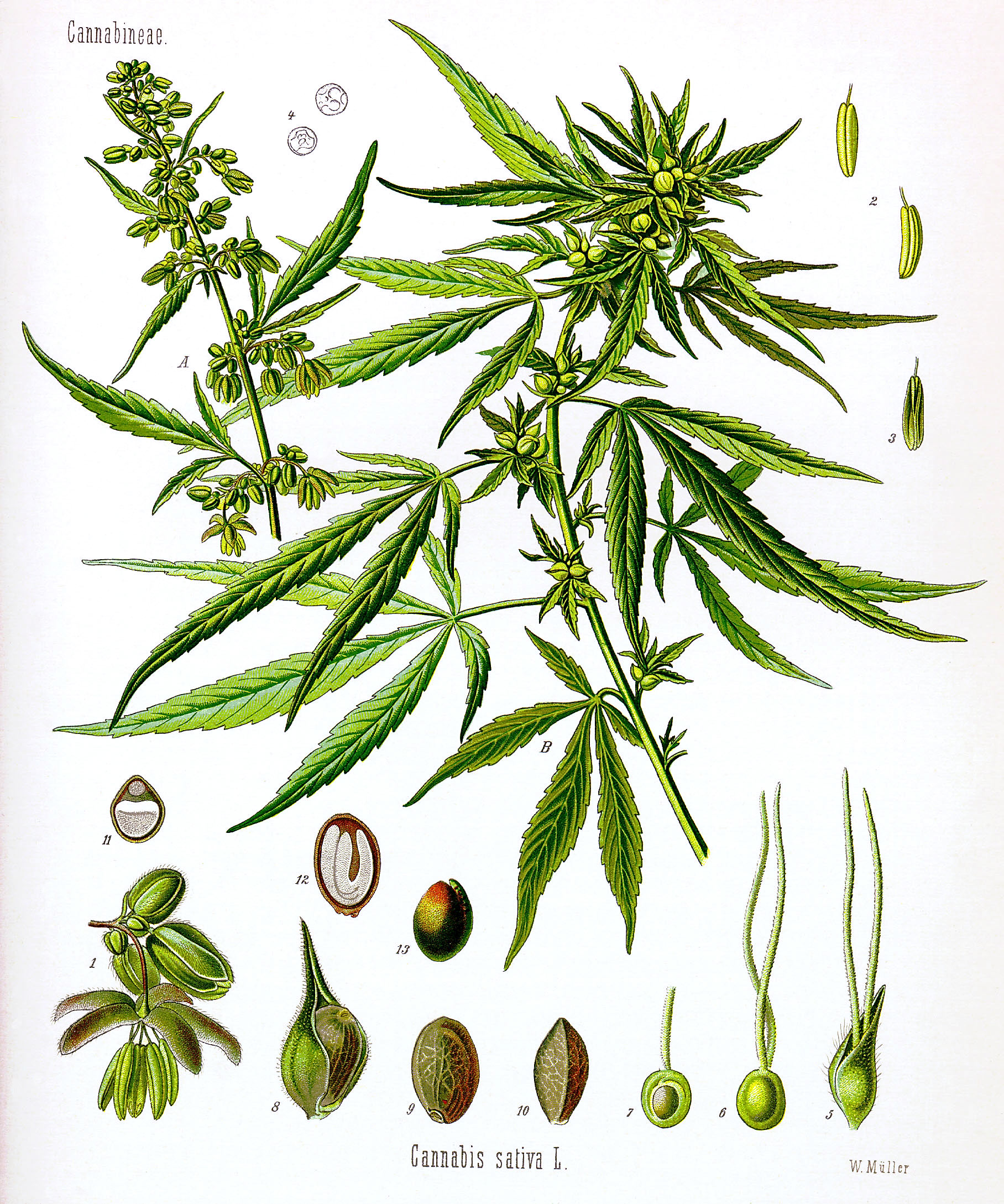
No doubt it will be helpful to found our discussion on a necessary botany lesson, especially since the most common misunderstanding about the “difference” between marijuana and industrial hemp is that “hemp is ‘the male’ and marijuana is ‘the female.’” In fact, nothing could be farther from the truth. “Cannabis” is the plant genus, “sativa” is Latin for “sown” or “cultivated” (and is included in many scientific plant species names), and the “L.” we often see associated with Cannabis sativa merely stands for the surname initial of Carl Linnaeus, the Swiss botanist who invented taxonomy. Cannabis sativa is a member of the Cannabaceae family. Within the Cannabis sativa plant species, we have the drug type known as “marijuana” and we have the oilseed and fiber type known as “industrial hemp.”

Both plant types – marijuana and industrial hemp – can be dieocious, which is to say they can be either exclusively male or exclusively female; and they can also be monoecious, which is to say they can have the staminate (i.e. the male pollen-producing part) and pistillate (i.e. the female ovum-producing part) on the same plant. However, marijuana is a high-resin crop generally planted about four feet apart for its medicine or narcotic rich leaves and buds, whereas industrial hemp is a low-resin crop generally planted about four inches apart for its versatile stalk and seed. The different kinds of marijuana are classified as “strains” and the different kinds of industrial hemp are classified as “varieties” and “cultivars.”

Industrial hemp is non-psychoactive with a higher ratio of CBD to THC, thus smoking even several acres of it will not result in achieving a high; conversely, only a memorable headache is achieved, regardless of Herculean effort. Marijuana flower production and industrial hemp production cultivation processes are distinctly different. Finally, there is no such thing as a plant or plant species known as “Cannabis hemp” and “hemp” is not a synonym for “marijuana,” “pot,” or “ganja,” etc. Botanists have argued for ages over whether a separate plant species “Cannabis indica” exists, and that age-old debate is not being addressed here.

The significant difference between the two types that effects cross-pollination and legitimately frightens marijuana growers is that hemp plants go to seed fairly quickly and would thus pollinate any marijuana plants growing in the same field or in a nearby field. This is botanically analogous to field corn and sweet corn, one of which is grown for human consumption, and one of which is grown for animal consumption. Corn producers take great measures to prevent any cross-pollination between their field and sweet corns; including growing the different varieties of corn at different times or making sure there is sufficient distance between the different fields. Either way, these corn producers do what is necessary to ensure that pollen carrying the dominant gene for starch synthesis is kept clear of corn silks borne on plants of the recessive (sweet) variety.

Cross-pollination of hemp with marijuana would significantly reduce the potency of the marijuana plants. While hemp farmers are not going to want marijuana cross-pollinating with their hemp and increasing their hemp’s THC content, it would be entirely more disastrous for the marijuana grower if hemp were to cross-pollinate with their marijuana due to the cost of producing and value of selling medical and adult-use marijuana. The concern is real. The concern is valid. But the concern does not merit the level of hysteria that appears to have arisen in Washington. We must take a note from Kentucky.

Industrial hemp is primarily pollinated by wind, and most pollen travels approximately 100 yards, give or take. Bees, of course, can also pollinate hemp; and bees travel up to three miles from their hives. It is also true that, depending on the weight and size of any plant pollen, combined with other natural conditions, wind-borne pollen can technically travel up to 2,000 miles away from the source. Yes, it’s true, up to 2,000 miles. And also it would be beyond ridiculous to give serious agricultural consideration to this extreme factoid for entirely obvious reasons.

Cannabis case in point: Kentucky. Kentucky may not have legal outdoor marijuana grows, but you’d better believe that – like every other state in the nation – there’s a whole lotta marijuana being deliberately cultivated outdoors; and on quite a grand scale in Kentucky, which state learned centuries ago that Cannabis grows exceedingly well in that climate and soil. Kentucky was always been the heart of our nation’s industrial hemp farmlands, thus Kentucky is covered with more feral hemp than any other state. This issue of marijuana and hemp cross-pollination is old news and no news at all to the marijuana growers of Kentucky, who experience and demonstrate no sense of hysteria like that which has risen up in Washington.

Global industrial hemp leader and professional industrial hemp agrologist Prof. Anndrea Hermann, M.Sc, B.GS, P.Ag., who has been a certified Health Canada THC Sampler since 2005 and is the President of the U.S. Hemp Industries Association, has assisted with creating and reviewing hemp regulations in Canada, the European Union, South Africa, Uruguay, Australia, New Zealand, and several U.S. States. Anndrea refers to this issue of cross-pollination as the “Cannabis Clash” and “Cannabis Sex 101.” So what is the answer? What is a safe distance between marijuana and hemp fields?

The Association of Official Seed Certifying Agencies (AOSCA), which is the global agency to which most developed countries subscribe for agricultural purposes, has completed its draft industrial hemp seed certification regulations, which rules include a range from a minimum distance of three (3) feet to a maximum distance of three (3) miles between different pedigrees and cultivars of industrial hemp. This is the same with Health Canada’s industrial hemp regulations. But we are talking about safe distances between two plant types – marijuana and industrial hemp. Absent intense research and collection of hard data that will be interesting to conduct as we move forward and funding becomes available, experts agree that a distance of ten (10) miles between hemp and marijuana fields is exceedingly appropriate to avoid cross-pollination. Or as Anndrea Hermann would say, “a nice, country road drive!”

This is not a complicated issue or a new issue. This is basic agriculture. Marijuana and industrial hemp are best friends and this is no time for them to start picking unnecessary fights with one another. Ten miles, folks; ten miles!

http://www.thesmokersclub.com/blog/wp-content/uploads/2014/08/WeedBee.jpg

http://upload.wikimedia.org/wikipedia/commons/7/79/Cannabis_sativa_Koehler_drawing.jpg

Joy Beckerman is the President Hemp Ace International LLC, and the director of the Hemp Industries Association, Washington Chapter

CONTINUE READING…

Categories: US Hemp Co Museum | Leave a comment

Hemp pilot projects finding fertile ground in Kentucky

Posted on March 26, 2015
by Dan Dickson


Image result for hemp fields in kentucky


Cynthiana farmer Brian Furnish has a successful tobacco and cattle operation but wants to make life better for his family and many other Kentucky farmers who once depended on tobacco for their living.

“I’ve seen what’s happened with the decline of tobacco,” said Furnish. “Central and eastern Kentucky need a new crop. If we can build an industry around hemp here, it’ll be beneficial to growers.”

Furnish is also the chair of the Kentucky Hemp Industry Council, a 16-member group from around the state and nation that represents various stakeholder in hemp’s future, from farmers and crop processors to industries and retailers that want to process and sell hemp products. Hemp’s fiber and oil can be used in a multitude of goods, including food, paper, building materials, beauty products and much more.

Kentucky is entering its second year of industrial hemp pilot projects. The first round in 2014 produced a wealth of data about production methods, seed varieties, harvesting, processing techniques and uses for harvested hemp.

“We’re looking to conduct a wide scope of pilot projects in 2015,” said Agriculture Commissioner James Comer, a strong advocate for hemp and a Republican candidate for governor.

“There are more agriculture processors in Kentucky today making an investment in the state, signing contracts and hiring people. This is something we’ll be able to look back at and say ‘This was a good decision,’” said Comer.

Comer says one company that showed an early interest in developing the state’s hemp industry is Dr. Bonner’s Magic Soaps, a company selling hemp formulated soaps, organic bars, lip balm and body care products, according to its website. The company donated $50,000 to aid the hemp council’s work in promoting a future for hemp in Kentucky.

Comer says hundreds of others have applied for permits to participate in this year’s hemp pilot program. “There’s no shortage of farmers who want to grow hemp,” he said.

Lexington attorney Jonathan Miller is legal advisor for the hemp council.

“We would like to resume our leading role as the industrial hemp capital of the globe,” he said.

Miller and others have lobbied Congress and President Barack Obama’s administration to try to regain full legalization of hemp, which was banned 75 years ago, along with its intoxicating plant cousin, marijuana.

In the last year, no hemp has been commercialized in Kentucky. It remains in the experimental stage.

Pages: 1 2

CONTINUE READING…

Categories: US Hemp Co Museum | Leave a comment