Who Is This Anti-Marijuana Zealot Sheldon Adelson?

C1_8734_r_x

I am writing today about a somewhat mysterious man who has spent tens of millions of dollars to try to prop up marijuana prohibition.

In fact, he has become the big fish in the anti-marijuana funding world. His name is Sheldon Adelson, and he is an 82-year-old Las Vegas casino owner (The Sands, The Venetian, and The Palazzo). He is reportedly worth $ 29 billion, making him the 12th-richest person in America.

Adelson once made the late website Gawker’s “Billionaire Shit List,” which called him “evil” for “spending hundreds of millions of dollars trying to get extreme right-wingers in office.” And he should be on our “sh*t list” as well for spending funds on prohibition, which as a policy has resulted in the needless arrest of more than 26 million Americans over the last 40 years.

Adelson was also the principal financial backer of Freedom Watch, a now-defunct political advocacy group founded to counter the influence of George Soros, the largest pro-legalization funder in the country, and liberal groups such as MoveOn.org. Freedom Watch spent $ 30 million of Adelson’s money in 2008 before fading into oblivion.

In 2014, Adelson gave $ 5.5 million to the Drug Free Florida campaign to help defeat the medical use initiative and has given another $ 1.5 million to fight the pending medical use initiative this year, with more likely to follow. He also just donated $ 1 million to the group opposing the legalization initiative on the ballot in Massachusetts.

In his home state of Nevada, where a full legalization initiative is on the ballot for this upcoming election, Adelson has donated $ 2 million to oppose the initiative. He recently purchased the Las Vegas Review-Journal for $ 140 million, since then the paper withdrew its prior endorsement of marijuana legalization for the state.

One cannot help but wonder what would motivate an individual to want to continue a failed public policy that results in the needless arrest of so many of our fellow citizens. In Adelson’s case, it was apparently a personal family tragedy. His 48-year-old son, Mitchell, died in 2005 of a drug overdose involving cocaine and heroin. Another son, Gary, has also struggled with drug addiction and is allegedly estranged from his father altogether. Adelson has said he sees marijuana as a “gateway drug” that led to his sons’ problems.

Of course, the so-called “gateway theory” has long since been refuted by serious scientists, including the National Academy of Sciences Institute of Medicine (“There is no conclusive evidence that the drug effects of marijuana are causally linked to the subsequent abuse of other drugs.”) and the Rand Corporation (“While the gateway theory has enjoyed popular acceptance, scientists have always had their doubts. Our study shows that these doubts are justified.”)

And the Netherlands Institute of Mental Health and Addiction recently reached this same conclusion: “As for a possible switch from cannabis to hard drugs, it is clear that the pharmacological properties of cannabis are irrelevant in this respect. There is no physically determined tendency towards switching from marijuana to harder substances. Social factors, however, do appear to play a role. The more users become integrated in an environment (“subculture”) where, apart from cannabis, hard drugs can also be obtained, the greater the chance that they may switch to hard drugs. Separation of the drug markets is therefore essential.”

In addition, those drug users who do end up using heroin or other far more dangerous drugs seldom start with marijuana. Rather recent research shows it is alcohol that is the first drug used in string of drugs leading to eventual addition, not marijuana.

One can surely sympathize with the sense of loss for any parent who experiences the death of a child, regardless of the cause. But these and other scientific findings suggest that If more jurisdictions legalize and regulate marijuana in a manner similar to alcohol — thereby allowing its sale to be governed by licensed, state-authorized distributors rather than by criminal entrepreneurs and pushers of various other, hard drugs — even fewer marijuana users will progress to other illicit drugs.

In some ways it reminds one of former Democratic Rep. Patrick Kennedy, the youngest son of longtime Sen. Ted Kennedy ( D-Mass.). Patrick Kennedy became addicted to pharmaceutical opioids, alcohol, and other illegal drugs before finally embarrassing himself and the Congress when he was arrested in 2006 after crashing his car into a barricade on Capitol Hill. At the time, he was high on OxyContin and drunk from alcohol. In Patrick Kennedy’s own words, “OxyContin was what I used for years, but I’m an addict, so it doesn’t matter what it is. I used benzodiazepines, alcohol, stimulants, Adderall, cocaine, you name it.”

In 2009 Kennedy again checked himself into a drug rehabilitation program.

Kennedy then co-founded Project SAM, the principal anti-marijuana organization working in the country to maintain marijuana prohibition. While that strategy may be therapeutically useful for the (hopefully) recovering addict, it places the burden for his problems unfairly on the rest of us.

In fact, recent studies have shown that in states in which medical marijuana have been legalized, the use of opioids has significantly declined.

It is a sad reflection on these two individuals that they use their wealth and fame to punish the rest of us, by working to slow the inevitable end of marijuana prohibition.

About 60 percent of Americans now support marijuana legalization, despite the efforts of Adelson and Patrick Kennedy to try to defend prohibition. Nonetheless, there is naturally some concern that this influx of big money might sway a sufficient number of voters to defeat some of the pending legalization initiatives. The defeat of the medical use initiative in Florida in 2014 (it had the support of 58 percent of those voting, but fell short of the 60 percent required for a constitutional amendment) is attributed by many observers to the out-of-state funding from Adelson.

In the end, our nation’s marijuana policy must be based on science and common sense, not on the tragic examples of those who were unable to control their addictions. I’m confident the pro-legalization forces, with our positive message of the benefits to society from legalization, will carry the day and that we will both out-raise funds and outspend our opponents in these upcoming voter initiative campaigns, not just this year, but for as long as it takes to finally end marijuana prohibition.

________________________________________________________________

This column was originally published on ATTN.com.

http://www.attn.com/stories/12217/sheldon-adelson-opposes-legalization-marijuana
 

NORML Blog, Marijuana Law Reform

Categories: Hemp History | Tags: , , , , | Leave a comment

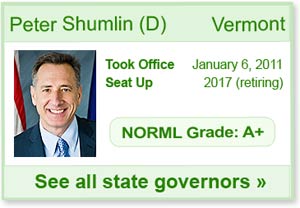
NORML Releases Gubernatorial Report Card: Learn Where Your Governor Stands On Marijuana Policy

Governors Scorecard

With the 2016 election only days away, NORML is pleased today to release of our first ever Gubernatorial Scorecard. Inspired by NORML’s Congressional Scorecard, this extensive database assigns a letter grade ‘A’ through ‘F’ to every state governor based upon his or her comments and voting records specific to matters of marijuana policy.

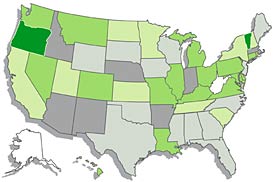
Public opinion in support of marijuana law reform is at an all-time high. Nonetheless, few federal lawmakers are espousing views on cannabis policy that comport with those of the majority of their constituents. As a result, most legislative activity specific to marijuana policy is taking place at the state level. America’s governors are our nation’s most powerful, state-elected officials and they therefore play a key role in this ongoing legislative debate. NORML’s new Scorecard provides voters in all 50 states with pertinent information regarding where their governor stands on issues surrounding cannabis policy.

KEY FINDINGS

  • 28 US governors received a passing grade of ‘C’ or higher (17 Democrats and 11 Republicans)
  • Of these, only two US governors, both Democrats, received an ‘A’ grade
  • 17 governors received a ‘B’ grade (11 Democrats and 6 Republicans)
  • Nine governors received a ‘C’ grade (5 Republicans and 4 Democrats)
  • 13 governors received a ‘D’ grade (All Republicans)
  • Seven governors received a failing ‘F’ grade (All Republicans)
  • Two governors received no grade because of insufficient data
  • Of the 31 Republican US governors currently in office, 11 of them received a passing grade of ‘C’ or higher (35 percent)
  • Of the 18 Democratic US governors currently in office, 17 of them received a passing grade of ‘C’ or higher (94 percent)

THE TAKEAWAY

Similar to the findings of NORML’s Congressional Scorecard, this gubernatorial analysis affirms that voters’ views on marijuana policy are typically more progressive than the views held by the highest elected officials in their states — 56 percent of whom received a passing grade from NORML. For example, while sixty percent of Americans support legalizing the use and sale of cannabis for adults, only four percent of state governors voice support for this position. Governors overall are also far less supportive of legislation to legalize the medical use of cannabis than are their constituents – approximately 80 percent of whom back these type of reform measures.

Governors ScorecardAlso evident is that gubernatorial support for marijuana law reform falls primarily upon partisan lines. While over 94 percent of Democratic governors received a passing grade of ‘C’ or higher (one Democrat received no grade), fewer than 40 percent of Republican governors did so. Further, all of the governors who received either a ‘D’ or a failing grade from NORML are Republicans. Conversely, both of the governors who received a ‘A’ grade from NORML are Democrats. This partisanship lies largely in contrast to voters’ sentiments, as the public tends to view many aspects of marijuana law reform, such as the regulation of medicinal cannabis, as non-partisan issues.

Commenting on the report’s findings, NORML Deputy Director Paul Armentano said: “It is apparent that voters’ views regarding marijuana policy have evolved significantly over the past decades. Yet, the positions of their governors have not progressed in a similar manner. Constituents ought to demand that their lawmakers legislate on behalf of policies that more closely reflect marijuana’s rapidly changing legal and cultural status.”

To read how NORML’s grades were calculated and to review the individual profiles for the governors of all 50 states, please visit: http://norml.org/us-governors.

NORML Blog, Marijuana Law Reform

Categories: Hemp History | Tags: , , , , , , , , , | Leave a comment

Values Survey: 63 Percent Of Americans Say Marijuana Should Be Legal

legalization_pollSixty-three percent of Americans age 18 and older favor making the use of marijuana legal, according to national polling results compiled by the Public Religion Research Institute’s American Values Survey.

The percentage is the highest ever reported by the poll, and marks a 30 percent increase in public support for legalization since 2014.

The poll possesses a margin or error of +/- 2.8 percentage points.

The results come only days after separate surveys released by the Pew Research Center and by Gallup also reported that Americans’ support for legalizing marijuana is at an all-time high.

NORML Blog, Marijuana Law Reform

Categories: Hemp History | Tags: , , , , , , | Leave a comment

Federal: Industrial Hemp Farming Act Pending in Congress

Federal legislation to amend the federal Controlled Substances Act to allow for the commercial cultivation of industrial hemp is pending in the United States House and Senate.

The Industrial Hemp Farming Act of 2013 amends the Controlled Substances Act to exclude industrial hemp from the definition of marijuana. The measure grants state legislatures the authority to license and regulate the commercial production of hemp as an industrial and agricultural commodity.

The House version of the bill, HR 525, has 41 cosponsors and has been referred to the Subcommittee on Crime, Terrorism, Homeland Security, And Investigations. The Senate version of the bill, S. 359, has four co-sponsors and has been referred to the Senate Judiciary Committee.

Efforts to attach this legislation as an amendment to the Senate Farm bill were unsuccessful.

Eight states – Colorado, Maine, Montana, North Dakota, Oregon, Vermont, Washington, and West Virginia – have enacted statutory changes defining industrial hemp as distinct agricultural product and allowing for its regulated commercial production. Passage of this amendment would remove existing federal barriers and allow these states and others the authority to do so without running afoul of federal anti-drug laws.

According to a Congressional Research Service report, “The United States is the only developed nation in which industrial hemp is not an established crop.”

To contact your elected officials in support of industrial hemp, please use the pre-written letter below. 

National Organization for the Reform of Marijuana Laws – Advocacy Campaigns

Categories: Industrial Hemp Legislation | Tags: , , , , , | Leave a comment

NORML vs Big Alcohol and Big Pharma

Hi, I’m Rick Steves, TV travel show host and a proud member of NORML’s Board of Directors. I’ve just returned from doing a barnstorming speaking tour in both Maine and Massachusetts to help build support for their legalization initiatives. It was an exhilarating week, meeting and talking with the good folks in those states, getting lots of great press, and feeling the excitement build in advance of what we expect will be victories in both states.

I’m investing my time and money in these latest state initiatives because I’ve seen first-hand the damage done to so many good, hard-working Americans because of a marijuana arrest. And we’ve got such a powerful message to share now that we have a solid legalization track record in my home state of Washington and in Colorado and Oregon: teen use does not go up, crime does not go up, and DUIs do not go up. The only thing that goes up is tax revenue and citizens exercising their civil liberty to smoke marijuana recreationally.

Rick Steves Donate to NORML

I’m doing my part to help end prohibition and all the damage it does to our society, will you stand with me in this fight?

Our political opponents and the big money special interests they represent, including both the alcohol and the pharmaceutical industries, are investing millions of dollars to stop us:

  • $ 3.5 million from Casino Magnate Sheldon Adelson to oppose legalization in Arizona, Nevada and Massachusetts.
  • $ 500,000 from opioid producer Insys to fight legalization in Arizona.
  • $ 75,000 from the Beer Distributors of Massachusetts and the Wine & Spirits Wholesalers of Massachusetts to oppose legalization in Massachusetts.
  • $ 10,000 from the Arizona Beer and Wine Wholesalers Association to oppose legalization in Arizona.

And that’s just to name a few.

We don’t have deep pocketed special interests funding our work, but we do have something more important and powerful … YOU!

So please, match my support and make a donation to NORML today and help us ensure that we not only win these current battles, but that we continue to expand the list of legalization states all across this country in 2017 and beyond.

Together, we have the power to end marijuana prohibition once and for all.

Let’s do it. Thanks!

Donate to NORML

NORML Blog, Marijuana Law Reform

Categories: Hemp History | Tags: , , | Leave a comment

Illinois: Lawmakers Fail To Consider Bill To Legalize Marijuana Production and Retail Sales

Lawmakers failed to consider legislation to legalize and regulate the adult use and retail sale of cannabis this legislative session. 

House Bill 4276, the Cannabis Regulation and Taxation Act, would have permitted those over the age of 21 to legally possess up to 30 grams of cannabis and/or to engage in the home cultivation of marijuana for non-commercial purposes (up to eight plants at any one time.) Adults would have been permitted to possess the full harvest from their plants and would not be subject to any taxation or commercial fees for engaging in home cultivation.

Existing criminal penalties involving the possession or cultivation of marijuana above these limits would have also been significantly reduced by HB 4276.

House Bill 4276 would additionally have established regulations governing a state-licensed market for the commercial production and retail sale of cannabis to adults. These activities would be subject to taxation. Thirty percent of all tax revenue generated by these taxes is designated to the Board of Education while another 10 percent is designated to address youth drug education and prevention services.

Passage of this measure would have eliminated nearly 50,000 annual marijuana possession arrests while raising revenue and bolstering the state economy. 

NORML would like to thank those of you who contacted your state lawmakers in support of this legislation.

For more information on this or other pending legislation, please contact Illinois NORML or follow them on Facebook.

National Organization for the Reform of Marijuana Laws – Advocacy Campaigns

Categories: Industrial Hemp Legislation | Tags: , , , , , , , , , | Leave a comment

Federal: Members Introduce Bipartisan Bill to Eliminate DEA Marijuana Eradication Program

Congressmen Ted Lieu (D-CA) and Justin Amash (R-MI) have introduced legislation, HR 3518, to eliminate the Drug Enforcement Administration’s Domestic Cannabis Eradication/Suppression Program.

The DEA program distributes funds to state and local law enforcement agencies for the purpose of locating and destroying marijuana cultivation sites. HR 3518 reads, “[B]eginning in fiscal year 2015, and for each fiscal year thereafter, no amounts in the Fund may be used for the Domestic Cannabis Suppression/Eradication Program of the Drug Enforcement Administration, or any substantially similar program.” 

In 2014, the federal government spent an estimated $ 18 million on the program to destroy 4.3 million plants, mostly in California.  In years past, the funding was primarily used for the purpose of uprooting feral marijuana plants (aka ditchweed).

“As multiple states legalize marijuana across our nation, it is a huge waste of federal resources for the DEA to eradicate marijuana. The federal government should focus its precious resources on other issues and let the states innovate in the cannabis field.” Representative Lieu said in a statement following the bill’s introduction.

Representative Amash added, “Civil asset forfeiture allows innocent people to have their property taken without sufficient due process, and this program encourages civil asset forfeiture by allowing the DEA to use the proceeds of seized property to fund marijuana prohibition enforcement. This is especially troubling given that the federal government should not be expending resources on marijuana prohibition—enforcement is a state-level issue, and an increasing number of states are deciding to back off from prohibition.”

Please enter your zip code below to urge your House member to support this legislation. 

National Organization for the Reform of Marijuana Laws – Advocacy Campaigns

Categories: Industrial Hemp Legislation | Tags: , , , , , , , , | Leave a comment

Florida: Unscientific Per Se Measure Dies In Committee

Legislation to impose ‘per se’ criminal penalties to individuals who drive a motor vehicle with trace levels (5ng/ml or higher) of THC in their blood — regardless of whether he/she is behaviorally impaired, has died in committee this legislative session. 

NORML opposes the imposition of this type of per se traffic safety legislation for cannabinoids because the presence of these compounds in blood are inappropriate and inconsistent indicators of psychomotor impairment. No less than the United States Traffic Highway Safety Administration (NHTSA) agrees, stating, “It is difficult to establish a relationship between a person’s THC blood or plasma concentration and performance impairing effects. … It is inadvisable to try and predict effects based on blood THC concentrations alone.”

Moreover, scientific studies find that THC may be present in blood for periods exceeding well over 24 hours in some users — long after any period of impairment has worn off.

We would like to thank those of you who contacted your lawmakers and urged them to reject this measure. 

National Organization for the Reform of Marijuana Laws – Advocacy Campaigns

Categories: Industrial Hemp Legislation | Tags: , , , , | Leave a comment

Federal: Measures Pending To Restore Financial Aid Eligibility To Marijuana Offenders

Legislation is pending in the House and Senate to restore federal financial aid eligibility to minor marijuana offenders.

In the House, H.R. 3561: The Fair Access to Education Act of 2015 would “exclude marijuana-related offenses from the drug-related offenses that result in students being barred from receiving Federal educational loans, grants, and work assistance, and for other purposes.”

In the Senate, S. 2557 The Stopping Unfair Collateral Consequences from Ending Student Success Act, or SUCCESS Act, repeals language in the Higher Education Act that strips students of aid because of a past drug offense, and removes the drug conviction question from the FAFSA form.

Between 2013 and 2014, 1,107 applicants lost eligibility for a full year of aid because of a drug conviction or a failure to report one, according to Department of Education.

Enter your zip code below to contact your House and/or Senate member and urge his/her support for this measures. 

National Organization for the Reform of Marijuana Laws – Advocacy Campaigns

Categories: Industrial Hemp Legislation | Tags: , , , , , , , | Leave a comment

Cannalytics Survey: Cannabis Consumers Most Likely To Identify As Independent Voters

ballot_box_leafAmericans who use cannabis or hold favorable views toward the plant tend to identify themselves politically as Independent rather than as a Democrat or a Republican, according to the results of a Cannalytics consumer research survey published today.

Among respondents, 46 percent defined themselves as Independent. Of this group, over 90 percent consider marijuana policy reform to be among the most important election issues, and more than 75 percent said that they are more motivated to vote this election because of pending cannabis-specific ballot measures.

Voters in nine states will decide on Election Day in favor of statewide ballot measures seeking to legalize either the medical use or the adult use of marijuana.

Cannalytics and its partners, including NORML, provided a 51-point questionnaire to over 5,800 respondents to gauge their opinions on cannabis policy, as well as their own marijuana use. Respondents typically were well educated, most did not smoke tobacco, and 53 percent suggested that they would consume less alcohol if cannabis were legally regulated for adults.

Full results of the 2016 Cannabis Voter Report are available online at: http://www.cannalytics.us/.

NORML Blog, Marijuana Law Reform

Categories: Hemp History | Tags: , , , , , , , , | Leave a comment