Doing study on coal-hemp, calls on changes in fed law

January 31, 2013

Patriot Energy joins state hemp association

CORBIN — By Jeff Noble, Staff Writer

Could industrial hemp be useful in reducing coal emissions and reclaiming mined coal fields in Kentucky?

And could the reclaiming bring a hike in southeastern and eastern Kentucky’s economy?

A bioenergy company with roots in the Tri-County thinks so.

Patriot Bioenergy Corporation recently became the first corporate member of the Kentucky Hemp Growers Cooperative Association, a Lexington-based organization that wants to make industrial hemp legal in the state — something that hasn’t been done since it was last grown during World War II as part of the nation’s war effort at home.
Patriot’s CEO Roger Ford said Wednesday industrial hemp can be grown in a variety of areas, including hillsides, which would complement the growing of energy beets for a biofuel on the company’s energy facilities, including those in the Williamsburg-Whitley County area.

“The optimal planting method seeds the plants closely together, which encourages the stalks of the plant to grow while the leaves grow smaller, increasing per-acre yields. That would work hand-in-hand with our Whitley County facilities. The industrial hemp seed can be processed into bio-diesel while the stalks are a cellulosic material, which is useful for a variety of things.”
Ford added Patriot’s focus would be to produce a biomass-coal blend from hemp and coal that would be what he called “torrified” — an energy process producing feedstock for energy production.

“The overall economic impact would be to diversify and improve the local economy by the production of industrial hemp. It would help agriculture and our project in particular.”
Patriot, based in Pikeville, is discussing the potential for using industrial hemp with coal companies. Ford said testing would be done at a laboratory in Magoffin County, with Patriot funding the research, and the results expected to be released in the middle of March. 
“We are currently conducting a feasibility study that will blend coal and hemp to measure the BTU values, as well as measure the emissions’ reclamation potential to hemp growing forward.”


Ford also brought up the possibility industrial hemp in Kentucky could also be used for energy and horse bedding at horse farms in the state and around the nation. A consultant with Ford on hemp research told Business Lexington magazine earlier this week the use of hemp as horse bedding is “straightforward and has been done.”

“The next step, conversion of the hemp-manure mixture to methane, is certainly viable, has been optimized ad published as recently as 2012 by a Finnish group. … Besides material for co-combustion with coal, we can produce biodiesel from the seed oil, which can be used as is or converted to jet fuel. Likewise, the whole plant can be used as a feedstock for fermentation of ethanol or longer chain fuels — gasoline, jet fuel, the list goes on — with huge markets associated. The ability to capture even small percentages of markets on this scale would be a tremendous boost to Kentucky,” Dr. Katherine Andrews told the magazine.

The state’s Commissioner of Agriculture, James Comer, wholeheartedly supports bringing industrial hemp back to Kentucky. Ford stated Patriot is working with Comer and the state’s Industrial Hemp Commission on the issue. He’s also encouraged with support in Frankfort and Washington from both political parties.

“Thus far, we’re encouraged with the bi-partisan support in Kentucky. Senator Sara Beth Gregory is a member of the Senate Agriculture Committee and we are hopeful that the committee will vote to send SB (Senate Bill) 50 to the full Senate in the next couple of weeks. … In addition, we are encouraged by the strong support from Senator Rand Paul, Congressman Barr, Congressman Yarmuth and Congressman Massie. We would hope that Senator McConnell and Congressman Rogers would weigh in and support this issue. Their leadership is needed in Washington and the people of Kentucky need a change in federal law so businesses and farmers can produce this crop and create jobs,” said Ford.
In Frankfort, Senate Bill 50 provides procedures that would allow and facilitate cultivating industrial hemp, if there is a similar change in Washington. While it’s not a drug like marijuana, federal law still says hemp is illegal.

According to an Associated Press story on Monday, Senator Paul Hornback (R – Shelbyville), chairman of the Senate Agriculture Committee, plans to bring the hemp bill up for a vote in his committee at a Feb. 11 hearing. U. S. Senator Paul is scheduled to appear in Frankfort and support the measure.

Ford noted that industrial hemp and marijuana cross-pollinates and diminishes the THC (Tetrahydrocannabinol) in marijuana.
“In short, it ruins the narcotic value of marijuana. It would be similar to planting field corn and sweet corn in the same field. For law enforcement to object to the production of industrial hemp on the basis that it poses a risk to narcotics enforcement is disingenuous at best. The fact is the cross-pollination would aid in the eradication of marijuana. Businesses or farmers would not seek to plant industrial hemp and marijuana in the same field, because that would obviously be counterproductive,” he said.

The Associated Press contributed to this article

Categories: US Hemp Co Museum | Tags: , | Leave a comment

U.S. Representative Massie Introduces Industrial Hemp Bill

For Immediate Release
Contact:

Wednesday February 6, 2013
(202) 225-3465

U.S. Representative Massie
Introduces Industrial Hemp Bill

“Industrial hemp is a sustainable crop and could be a great economic opportunity for Kentucky farmers”

WASHINGTON – Today, Congressman Thomas Massie (R-KY) introduced federal legislation that requires the federal government to respect state laws allowing the growing of industrial hemp. H.R. 525, the Industrial Hemp Farming Act of 2013, amends the Controlled Substances Act to exclude industrial hemp from the definition of marijuana. Rep. John Yarmuth (D-KY) is a co-sponsor of the bill in the U.S. House. Senator Rand Paul (R-KY) and Republican Leader Mitch McConnell (KY) are supporting a similar bill in the U.S. Senate.
“Industrial hemp is a sustainable crop and could be a great economic opportunity for Kentucky farmers,” said Rep. Massie.  “My wife and I are raising our children on the tobacco and cattle farm where my wife grew up. Tobacco is no longer a viable crop for many of us in Kentucky and we understand how hard it is for a family farm to turn a profit.  Industrial hemp will give small farmers another opportunity to succeed.”

On the federal level, Rep. Massie is taking the lead in Congress as the original sponsor of industrial hemp legislation. Also, this week Massie will testify before the Kentucky legislature along with other members of Kentucky’s federal delegation and Kentucky’s Commissioner of Agriculture James Comer in support of a related state bill.
Kentucky was a leading producer of the world’s industrial hemp supply during America’s early years as a nation. It is used in hundreds of products including paper, lotions, clothing, canvas, rope, and can be converted into renewable bio-fuels more efficiently than corn or switch grass. Critics of industrial hemp mistakenly equate it to marijuana.  The plants are cousins in the cannabis family but industrial hemp contains very small amounts of the intoxicant (THC) found in marijuana, making it ineffective as a drug.  Hemp is grown in over 30 western nations including Canada, England and France.

H.R. 525 has 28 original co-sponsors in the House, including House Agriculture Committee ranking member Collin Peterson (D-MN). Massie co-sponsored a similar bill in the 112th Congress.

###

CONTINUE READING…

Categories: US Hemp Co Museum | Tags: , , , , , , , , | Leave a comment

U.S. congressmen, former CIA director to testify in support of Kentucky hemp bill

Staff report

hemp

Industrial hemp is a fiber and oil seed crop

with a wide variety of uses. Hemp fibers

have been used to manufacture hundreds

of products that include twine, paper,

construction materials, carpeting and clothing.


FRANKFORT, Ky. — U.S. Sen. Rand Paul, U.S. Reps. John Yarmuth and Thomas Massie, former Director of Central Intelligence R. James Woolsey (of the Clinton Administration), and Commissioner of Agriculture James Comer will testify next week in support of an industrialized hemp bill.

Industrial hemp is a fiber and oil seed crop with a wide variety of uses. Hemp fibers have been used to manufacture hundreds of products that include twine, paper, construction materials, carpeting and clothing.

The Senate Agriculture Committee will hear the testimony Monday, Feb. 11 at 11 a.m. in Room 131 of the Capitol Annex in Frankfort. Senate Bill 50, sponsored by Sen. Paul Hornback, R-Shelbyville, establishes a framework to re-introduce industrial hemp into Kentucky’s agri-economy if and when the federal government acts to legalize it.

Immediately following the vote on SB 50, the group will move to Room 154 of the Capitol Annex to take questions from the media.

The bill has support from several groups and legislators. Its biggest critics are Operation UNITE, the Kentucky Narcotic Officers’ Association and the Kentucky Association of Chiefs of Police.

Operation UNITE said industrial hemp production in Kentucky is not economically sound, that it would impose an unnecessary financial burden on the state and could facilitate future efforts to legalize its cousin – marijuana. Police groups also say the legalization and growth of hemp in Kentucky would impede law enforcement officers’ marijuana eradication efforts, because “the plants are indistinguishable to the eye,” said Tommy Loving, executive director of the Kentucky Narcotic Officers’ Association.

The Kentucky Industrialized Hemp Commission says Kentucky has the perfect climate and soil to produce industrial hemp, and the farmers to grow it. Comer believes the crop could be a great economic boon to Kentucky.

The group recently commissioned an economic impact study to be performed by the University of Kentucky College of Agriculture. It hopes such a study could have an impact on the discussion at the federal level to legalize industrial hemp.

CONTINUE READING…

Categories: US Hemp Co Museum | Tags: , , , , , , , | Leave a comment

Tell The Children the Truth

Trace the rich History and Science of the worlds most valuable plant.
Discover  how hemp is a leading, cellulose, fiber, food and bio-fuel solution.
 

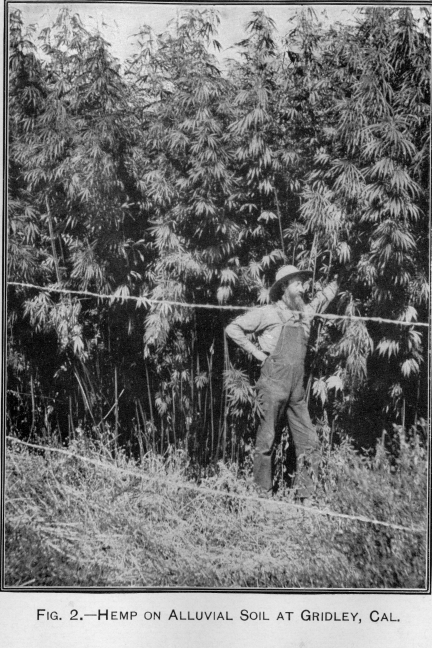
1903-USDA-GRIDLEY, CA, US Hemp Museum

U.S. Hemp Co. is a  non-profit organization dedicated to revealing hemp's great potential to help solve many of our environmental, financial, and social challenges.  Originally located in downtown Santa Cruz, CA, we are now in cyberspace to reach the masses.

Hemp is now grown commercially in 31 different countries, including England, France, Spain, Canada and Australia.  Hemp is legally recognized as a natural resource by the United Nations Single Convention on Narcotic Drugs, the North American Free Trade Agreement (NAFTA) and the General Agreement on Tariffs and Trade (GATT). However, the U.S. is the only industrialized country in the world that still prohibits the growth of industrial Hemp. 

Hemp offers a solution to the impending ecological disaster with a return to a plant-based economy, where fuel comes from agricultural hemp biomass, clothes come from eco-friendly hemp strands, food and oils from the highly nutritious hemp seed, paints and lubricants from hemp seed oil, and superior paper products are made from renewable hemp. The hemp revolution will restore sustainable local agricultural communities, taking away profits from politically powerful oil, chemical and pharmaceutical companies, and preventing costly wars, toxic pollution. and economic uncertainty. 


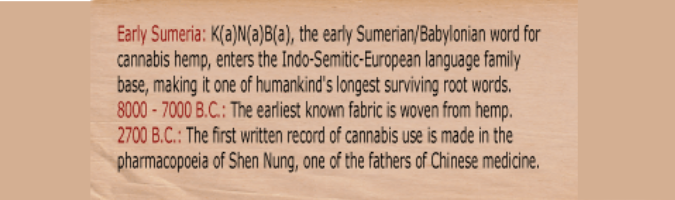
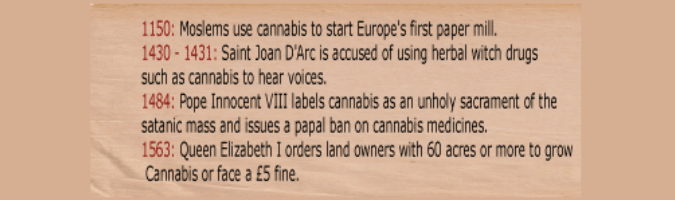
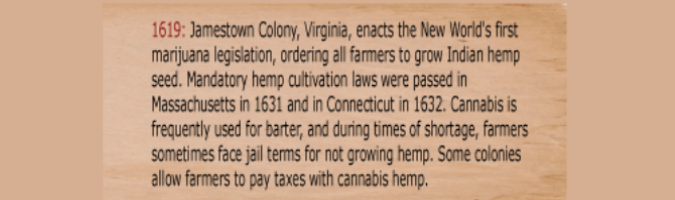
TIMELINE

Sun though Hempwear-it- at the US Hemp Museum


eat-it-at US Hemp Museum


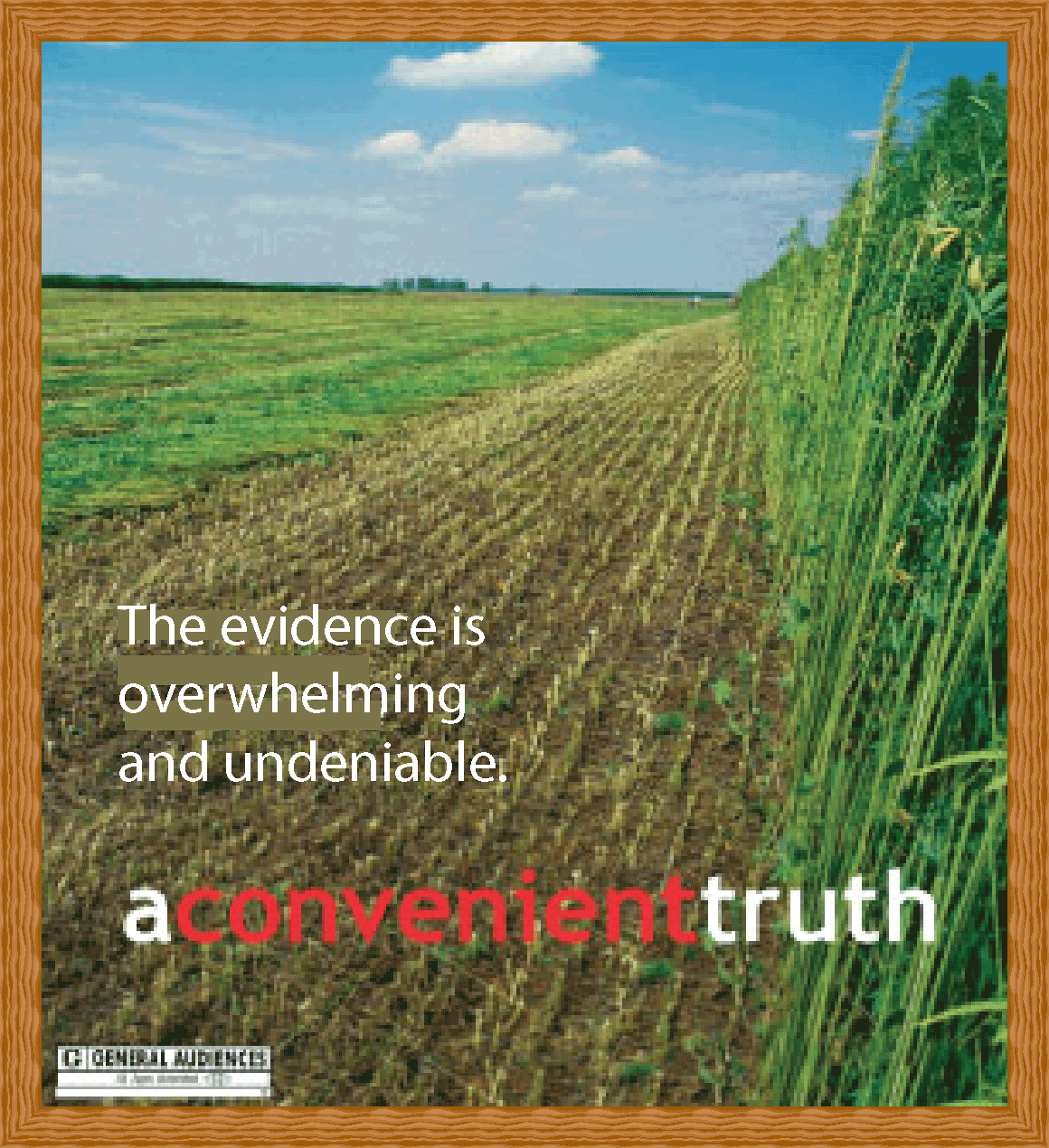
Hemp A Convenient Truth


live-it-at the US Hemp Museum


U.S. Hemp Co. is a  non-profit organization dedicated to revealing hemp's great potential to help solve many of our environmental, financial, and social challenges.In an age of mass consumption, US Hemp Co stands as a hopeful vision of what is possible when we view ourselves as citizens instead of consumers.  We are focused on a single goal: to focus on cooperation and community instead of competition and profits.

Categories: US Hemp Co Museum | 2 Comments