Legislation that sought to reduce marijuana possession penalties was unfortunately defeated this legislative session.
National Organization for the Reform of Marijuana Laws – Advocacy Campaigns
|
You are using an insecure version of your web browser. Please update your browser!
Using an outdated browser makes your computer unsafe. For a safer, faster, more enjoyable user experience, please update your browser today or try a newer browser.
|
Legislation that sought to reduce marijuana possession penalties was unfortunately defeated this legislative session.
National Organization for the Reform of Marijuana Laws – Advocacy Campaigns
Lawmakers have failed to act on legislation to decriminalize the possession of up to one ounce of marijuana by adults.
The measure was previously approved by the Senate Committee on Health but members of the Senate Committee on Judiciary and Labor failed to take further action. Similar decriminalization measures — SB 666, SB 879 , SB 708, and SB 681 were also never considered in the Senate. HB 372 was never heard in the House.
National Organization for the Reform of Marijuana Laws – Advocacy Campaigns
House lawmakers failed to act on legislation to permit the personal cultivation and retail sale of marijuana by adults.
National Organization for the Reform of Marijuana Laws – Advocacy Campaigns
There are right ways to fight the unconstitutional federal prohibition on industrial hemp. There are also wrong ways to do it. Unfortunately, Kentucky is doing it the wrong way. Rather than act without unnecessary federal “permission,” the agriculture commissioner is pleading with the feds to “reconsider” its rules for industrial hemp.
The feds recently put out a report called the Statement of Principles on Industrial Hemp which outlines how federal laws impact hemp production for research purposes. However, the Kentucky agriculture commissioner says it is not certain how the rules apply to hemp oil (CBD oil) production research, which makes up over half of the state’s hemp programs.
“There are some areas(of the report) that may be problematic, including the definition of what the actual definition of what industrial hemp is,” said Quarles. He added that he hopes “those in Washington realize that the entire plant should be researched.”
While industrial hemp and recreational marijuana are both prohibited under the Controlled Substance Act of 1970, they are different strains of the same plant. Industrial hemp has practically no trace of THC, the chemical in found in marijuana that makes it potent. While it is not illegal to grow industrial hemp, farmers must obtain a permit from the DEA, a virtually impossible feat. Up until a couple of years ago, the feds effectively maintained complete prohibition of industrial hemp production.
At one time, Kentucky ranked as the no. 1 hemp producing state in the country, and the commonwealth currently has a strong grassroots network of hemp advocates. But when the legislature took up the issue in 2013, it only authorized hemp production if and when the feds allowed it.
Early in 2014, President Barack Obama opened the door when he signed a new farm bill into law, which included a provision allowing a handful of states to begin limited research programs growing hemp. The “hemp amendment”
…allows State Agriculture Departments, colleges and universities to grow hemp, defined as the non-drug oil-seed and fiber varieties of Cannabis, for academic or agricultural research purposes, but it applies only to states where industrial hemp farming is already legal under state law.
With the federal government granting its limited permission, the state of Kentucky launched a hemp pilot program meeting the federal guidelines in 2014. Now, state agriculture officials find themselves in a position where they must beg the federal government to change its rules in order to even run its limited research program.
Meanwhile, other states including Colorado, Vermont, Oregon, South Carolina, Connecticut, Maine and North Dakota aren’t waiting around for permission. They have taken steps to ramp up industrial hemp production on their own, simply ignoring federal prohibition and legalizing industrial hemp within their state borders.
While prospective hemp growers still have to take federal law into consideration, by eliminating the state requirement for federal permission, state hemp legalization clears away a major obstacle to widespread commercial hemp farming within the borders of the state.
And it’s working. For instance, in Colorado the amount of acreage used to grow industrial hemp is poised to double this year.
The growing hemp industry in Colorado and other states acting independent of federal law shows that the fed’s ban does not work without state cooperation.
Kentucky should cease pleading for permission where none is required and takes steps to nullify the federal ban on industrial hemp by simply creating a framework allowing farmers to cultivate and process hemp for both commercial and research purposes.
RELATED:
Members of the House previously approved the measure in a 102-34 vote, however members of the Senate Judicial Proceedings committee failed to consider the legislation before session came to a close.
National Organization for the Reform of Marijuana Laws – Advocacy Campaigns
NORML released our updated and revised 2016 Congressional Scorecard this week in conjunction with National Voter Registration Day. The Scorecard is an all-encompassing database that assigns a letter grade ‘A’ through ‘F’ to members of Congress based on their marijuana-related comments and voting records.
With the 2016 presidential election drawing closer and statewide marijuana initiatives qualified for the ballot in nine states, we need YOU to make it out to the polls to support ending cannabis prohibition. Double-check your status as a voter and encourage your friends and family to do the same. Take a look at how we graded your members of Congress and bring that information with you to the polls on Election Day!
Federal: Members of Congress have approved a short-term spending bill that keeps in place existing provisions protecting those who engage in the state-sanctioned use and dispensing of medical cannabis from undue prosecution by the Department of Justice. The amendment, known as the Rohrabacher-Farr Amendment, maintains that federal funds can not be used to prevent states from “implementing their own state laws that authorize the use, distribution, possession or cultivation of medical marijuana.” Federal lawmakers will revisit the FY 2017 spending appropriation after the Election.
State:
California: On Tuesday, the California Nurses Association/National Nurses United, the nation’s largest state organization of nurses, announced that it has endorsed Proposition 64, the Adult Use of Marijuana Act.
Deborah Burger, President of the California Nurses Association/NNU said, “California Nurses believe strongly that the prohibition and criminalization of marijuana has ruined generations of lives, wasted hundreds of millions of taxpayer of dollars and failed to protect the public health and safety. California needs a new approach and Proposition 64 is carefully crafted to strictly regulate adult-use marijuana while funding critical youth programs and safeguarding children, workers and local communities.”
Proposition 64 permits adults to legally grow (up to six plants) and possess personal use quantities of cannabis (up to one ounce of flower and/or up to eight grams of concentrate) while also licensing commercial cannabis production and retail sales. The measure prohibits localities from taking actions to infringe upon adults’ ability to possess and cultivate cannabis for non-commercial purposes. The initiative language specifies that it is not intended to “repeal, affect, restrict, or preempt … laws pertaining to the Compassionate Use Act of 1996.”
The California Nurses Association joins the ACLU of California, the California Democratic Party, the California Medical Association, California Lt. Gov. Gavin Newsom, the California NAACP, the California League of Conservative Voters, Equality California, the Drug Policy Alliance, Students for Sensible Drug Policy, and NORML in its support for Proposition 64.
Maine: Polling data compiled by the University of New Hampshire finds that likely voters support Question 1, the Marijuana Legalization Act, by a margin of 53 percent to 38 percent.
If enacted by voters in November, Question 1 would allow adults to legally possess up to two and one-half ounces of marijuana and to cultivate marijuana (up to six mature plants and the entire yields of said plants) for their own personal use. The measure would also establish licensing for the commercial production and retail sale of cannabis. Retail sales of cannabis would be subject to a ten percent sales tax. Non-commercial transactions and/or retail sales involving medical cannabis would not be subject to taxation.
Massachusetts: A new WBZ-TV/UMass Amherst poll finds that a majority of voters back Question 4: The Regulation and Taxation of Marijuana Act. The measure leads in the poll by a 53 percent to 40 percent margin.
If enacted, Question 4 allows adults 21 years of age and older to possess up to one ounce of marijuana outside of their residences and up to 10 ounces of marijuana in an enclosed, locked space within their residences, which mimics the current in-residence allowance established by the Massachusetts Department of Public Health for medical marijuana patients. It allows adults 21 years of age and older to grow up to six marijuana plants in an enclosed, locked space within their residences and possess the marijuana produced by those plants in the location where it was grown.
Tennessee: Members of the Memphis City Council are following in the footsteps of the Nashville Metro Council by approving a local ordinance to provide local police the discretion to issue $ 50 citations for those who possess up to a half-ounce of marijuana. Under state law, the possession of small amounts of cannabis is classified as a criminal misdemeanor, punishable by up to one year in jail and a criminal record. Council members approved the ordinance last week in it’s second reading, with the third and final reading taking place October 4th. If you live in Memphis, consider contacting your member of City Council to urge their support for this common sense measure.
House legislation, HB 1054, to redefine industrial hemp as an agricultural crop and establish licensing regulations for the plant’s cultivation has been tabled for the legislative session.
The legislation was approved by the full House in an 57-11 vote on Thursday, February 4th but unfortunately members of the Senate Agriculture and Natural Resources committee voted against it in a 5-4 vote.
National Organization for the Reform of Marijuana Laws – Advocacy Campaigns
Those of us involved in the marijuana legalization movement have long assumed that those companies that produce and sell competing products — especially alcohol and tobacco — were working behind the scenes to try to maintain marijuana prohibition and to protect their duopoly for legal recreational drugs. These industries have lobbyists who regularly work with state and federal elected officials to keep legal marijuana off the market.
But we now see the pharmaceutical companies are also getting directly involved in political efforts to maintain marijuana prohibition, worried that legal marijuana will undermine their bottom line.
Pharmaceutical company joins the war on marijuana smokers.
Recently, we saw the first direct evidence that pharmaceutical companies are now working to defeat marijuana legalization efforts, acknowledging that their intent is to protect their market in synthetic opioid drugs.
Earlier this month, Insys Therapeutics Inc., an Arizona-based company, donated $ 500,000 to a group calling itself Arizonans for Responsible Drug Policy, a newly formed organization established to try to defeat Proposition 205, the marijuana legalization voter initiative that will appear on the ballot this November in that state.
Insys currently markets just one product, Subsys, a sublingual fentanyl spray, a synthetic opioid far more potent than heroin (fentanyl is the drug found in Prince’s system following his death in April). “Insys Therapeutics made $ 62 million in net revenue on Subsys fentanyl sales in the first quarter of this year, representing 100 percent of the company’s earnings,” according to The Washington Post. “The CDC has implicated the drug in a ‘surge’ of overdose deaths in several states in recent years.”
Survey data compiled from medical marijuana patients show that subjects often reduce their use of prescription drug therapies — particularly opioids — when they have legal access to cannabis. According to a 2015 RAND Corp. study, opiate-related abuse and mortality is lower in jurisdictions that permit medical cannabis access, compared to those that outlaw the plant.
Insys has come under scrutiny of law enforcement. According to The Washington Post, a number of states are currently investigating Insys for illegally paying physicians to prescribe their drug in situations in which it was inappropriate. Illinois Attorney General Lisa Madigan filed a lawsuit against the company, claiming the company’s “desire for increased profits led it to disregard patients’ health and pushed addictive opioids for non-FDA approved purposes.”
The smoking gun.
When the company first made its half-million dollar contribution to the group opposing the Arizona legalization initiative — the largest single contribution to the group by a factor of four — the company claimed that its reason for opposing the voter initiative was “because it fails to protect the safety of Arizona’s citizens and particularly its children.”
But when the company filed a legally required disclosure statement with the Securities and Exchange Commission, it acknowledged to shareholders that it was making the donation because it feared a decline in the sales of its powerful opioid product and that of a second drug it is developing: Dranabinol, a synthetic cannabinoid. Synthetic cannibinoid is a blanket term for an artificial version of tetrahydrocannabinol, or THC — the active compound in the marijuana plant — intended to alleviate chemotherapy-caused nausea and vomiting. The company concedes that the scientific literature has confirmed the benefits of natural marijuana over synthetic THC:
“Legalization of marijuana or non-synthetic cannabinoids in the United States could significantly limit the commercial success of any dronabinol product candidate. … If marijuana or non-synthetic cannabinoids were legalized in the United States, the market for dronabinol product sales would likely be significantly reduced, and our ability to generate revenue and our business prospects would be materially adversely affected.”
The Arizona Republic reported that the company, while publicly claiming to have kids’ best interests in mind, is clearly more concerned with ways to “protect its own bottom line.”
And the company has good reason for that fear. Recently published studies have found that states that provide for the legal use of medical marijuana had a 25 percent decline in opioid prescriptions. Another recent study from Columbia University found the implementation of medical marijuana programs is associated with a decrease in the prevalence of opioids detected among fatally injured drivers, based on a review of 69,000 fatalities in 18 states, according to data published in the American Journal of Public Health. Where legal marijuana is available, people use far fewer opioid drugs.
So we now have direct evidence that this pharmaceutical company in Arizona is spending large amounts of money to avoid having to compete with legal marijuana, in order to protect its market share for an addictive and dangerous synthetic opioid and a synthetic form of THC, at the expense of public health.
This is not the first instance of pharmaceutical companies pouring money into the “war on drugs.” In 2014, The Nation published an article revealing that the makers of Oxycontin and Vicodin were two of the largest contributors to The Partnership for Drug Free Kids and the Community Anti-Drug Coalition of America, two groups that oppose marijuana legalization and support continued prohibition.
Insys will certainly not be the last pharmaceutical company caught putting company profits ahead of concern for public health, but it is the first instance we have seen where a company was caught with its hands in the cookie jar, opposing a marijuana legalization initiative purely for reasons of corporate greed.
Tobacco and alcohol companies have long opposed legal marijuana.
It is understandable that recreational and pharmaceutical industries would not wish to compete with legal marijuana. By any measure, their products are far more dangerous and far more addictive.
Overdose Deaths.
For comparison purposes, according to the National Institute on Alcohol Abuse and Alcoholism, excessive alcohol use results in approximately 88,000 deaths per year in this country. And, according to the Centers for Disease Control and Prevention, tobacco smoking results in more than 480,000 deaths each year in this country, about 1,300 people each day.
A 2014 study by Johns Hopkins University found that states that legalized medical marijuana saw a 25 percent decline in overdose deaths from prescription drugs.
Marijuana has never caused an overdose death in the history of mankind. According to a recent report from the World Health Organization, one would have to smoke “between 238 and 1,113 joints a day – or at least 10 joints an hour, for 24 hours straight – before overdose would become a realistic concern” for marijuana.
Addictive potential.
While one can develop a dependence on marijuana smoking, the threat of dependence with marijuana is far less than with either alcohol or tobacco. Here is what the National Academy of Sciences Institute of Medicine concluded in regard to cannabis’ potential dependence liability, in the context of other controlled substances:
“In summary, although few marijuana users develop dependence, some do. But they appear to be less likely to do so than users of other drugs (including alcohol and nicotine), and marijuana drug dependence appears to be less severe than dependence on other drugs.”
Here are their dependence ratings:
Tobacco: 32 percent (proportion of users who ever become dependent)
Heroin: 23 percent
Cocaine: 17 percent
Alcohol: 15 percent
Anxiolytics/sedatives: 9 percent
Marijuana/hashish: 9 percent
So if one is electing to use a recreational drug, marijuana is clearly the safest alternative. And if one is using an opioid drug for pain, they should experiment with marijuana as a substitute for the more dangerous and addictive opioids. For many, it is an effective and far less dangerous alternative.
_____________________________________________________________________
Keith Stroup is a Washington, D.C. public-interest attorney who founded NORML in 1970.
This column was first published in ATTN.com.
http://www.attn.com/stories/11586/pharmaceutical-company-admits-opposing-marijuana-legalization
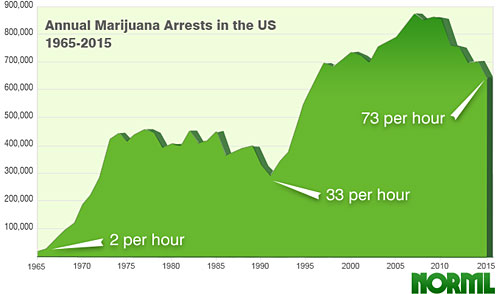
Marijuana-related arrests in the United States have fallen to their lowest levels since the mid-1990s, according to data released today by the US Federal Bureau of Investigation.
According to the FBI’s Uniform Crime Report, police made 643,122 arrests for marijuana-related offenses in 2015. Of those arrested, 574,641 (89 percent of all marijuana-related arrests) were charged with marijuana possession only, not cultivation or trafficking.
The annual arrest total represents more than a 25 percent decline since 2007, when police arrested a record 872,721 Americans for violating marijuana laws.
Since 2012, four states and the District of Columbia have legalized the adult use and possession of personal quantities of cannabis, leading to a dramatic decline in marijuana-related arrests in those jurisdictions.
As in previous years, marijuana possession arrests were least likely to occur in the western region of the United States, where possessing the plant has largely been either legalized or decriminalized.
According to 2016 nationwide survey data compiled by the Associated Press, some six out of ten Americans now say that the adult use of marijuana should be legally regulated.